Get Full Government Meeting Transcripts, Videos, & Alerts Forever!
Get email alerts on the Heat Protection Farmworkers topic
No spam. Unsubscribe anytime.
Advocates: North Carolina lacks state heat protections for farmworkers; local action urged
Summary
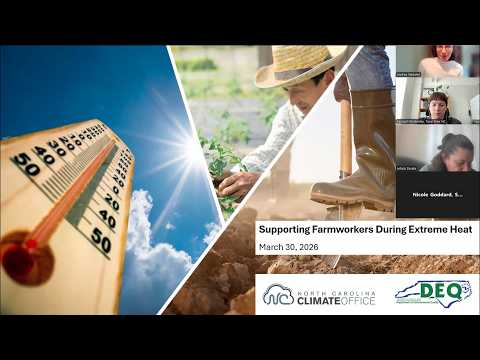
Speakers at a recorded State Resilience Office webinar warned that North Carolina has no state heat-protection standard for outdoor workers, described housing and emergency-response gaps affecting H-2A and other farmworkers, and urged local governments to adopt heat policies and update mapping and outreach.
At a recorded session hosted by the State Resilience Office and the North Carolina Heat Stress Coalition, advocates and farmworker leaders said North Carolina has no statewide standard protecting outdoor workers from extreme heat, leaving H-2A and other farmworkers exposed to preventable risks.
Kendall Lemberly, policy manager at Toxic Free NC and a coordinator of the state coalition, described the kinds of protections that formal standards can require — training, emergency plans, heat thresholds that trigger longer breaks, shade, water, and acclimatization periods — and urged local governments to adopt written plans. Lemberly said the federal Occupational Safety and Health Administration proposed a ‘‘heat injury and illness prevention’’ rule in summer 2024 and that public comments closed in January 2025, but a final federal standard could take years. As Lemberly put it when explaining the legal basis for enforcement, workplaces should be "free from recognized hazards that are causing or likely to cause death or serious injury."
Speakers emphasized that existing protections do not always reach farmworkers. "Water is something that's required," Lemberly said, noting that cool water is required under field sanitation rules but is often not plentiful on the ground. She cited acclimatization — ramping up hours slowly for workers new to hot conditions — as a proven life-saving step that is not currently required in North Carolina.
Leticia Zavala, coordinator of the farmworker-led organization It's Our Future, described the scale and vulnerabilities of the workforce: "There's approximately 200,000 farm workers in the state," she said, adding that about "30,000" of those are H-2A visa workers whose housing, transportation and immigration status are tied to employers. Zavala recounted crowded housing, limited bathroom and shower capacity, lack of air conditioning in many units and the absence of reliable addresses for housing and remote fields — factors she said that delay emergency response.
Zavala recounted a severe heat-illness case in which a 19-year-old H-2A worker collapsed after water ran out; he "was in a coma for about three weeks" and suffered lasting brain damage, she said, and the employer fired him and family members before he had recovered. Zavala said cross-border complications and the family's return to Mexico made access to workers' compensation and legal representation difficult.
Speakers also described enforcement limits. Zavala said OSHA is underfunded at the state level and cited about "7 inspectors" who cover housing and related complaints; she also said that anonymous complaints can lose confidentiality if a grower appeals a fine, which discourages reporting.
Asked whether growers accept changes such as training or schedule adjustments, presenters said responses vary. Smaller, family-run farms sometimes agree to shift schedules or rotate workers to cooler tasks; larger operations with many workers often resist, calculating the financial impact of more or longer breaks. An attendee who identified herself as Adrienne, a county health department participant, asked about outreach obstacles and was told coalition members do in-person outreach (for example on Sundays at grocery stores) and can help with county-level planning.
To reduce risk immediately, presenters urged local officials and emergency planners to: adopt heat policies and written plans that include training and emergency procedures; update GIS and address databases to include farm properties and worker housing; train local health and emergency staff to support heat events; run public outreach and resource drives (hydration packets and communications in languages workers speak); and partner with community organizations that already serve farmworkers. "We recommend adopting and implementing a heat policy, making a plan that includes training, creating emergency procedures," Lemberly said.
Presenters offered to meet with counties and local agencies for targeted support and said the North Carolina Heat Stress Coalition has templates and resources. The session was recorded for DEQ's YouTube channel and coalition organizers said they will share materials with cohort participants and local partners.
The session closed with presenters urging local steps to fill enforcement and information gaps while the federal rulemaking proceeds.