Get Full Government Meeting Transcripts, Videos, & Alerts Forever!
Get email alerts on the Zoning UDO topic
No spam. Unsubscribe anytime.
Snellville council adopts wide-ranging UDO text amendments to modernize zoning rules
Summary
The Snellville mayor and council on July 13, 2026, approved UDO 26-01, a multi-chapter text amendment that updates definitions, clarifies residential district uses, adjusts accessory-structure permitting, allows behavioral health facilities subject to special-use permits and revises the tree and lighting ordinances.
The Snellville mayor and council voted unanimously July 13 to adopt UDO 26-01, a citywide cleanup and modernization of the Unified Development Ordinance.
Jason Thompson, the city’s planning director, told the council the package updates chapter 100 definitions, removes the planning commission chair’s signature requirement for final plats so the planning director signs final plats, and clarifies split-zoning interpretation and the definition of "principal building." Thompson described the change as efficiency-focused: "as the UDO and the needs of the city change, so does the UDO. It's our toolbox..." He added that final administrative tasks historically signed by many reviewers are better consolidated so the planning department can handle day-to-day approvals.
The amendment restructures some residential districts, limiting the RM district to multifamily and apartment uses while reallocating other uses to dedicated districts. Thompson said the rewrite also standardizes townhome design, requiring rear-entry townhomes by default and establishing a 15-foot buffer where townhomes abut lower-density single-family lots to reduce impacts on existing neighborhoods.
The update changes accessory-structure permitting in RS-15 and RS-30 residential districts: prefabricated sheds under 120 square feet may be installed without a building permit provided they meet setback rules; "stick-built" foundations still require permits and building-inspector review. Carports are again allowed as stand-alone, wood-framed structures designed to match the house facade; pre-fabricated metal shelters remain prohibited as stand-alone units.
On uses, Thompson said the UDO now allows behavioral health facilities as defined by the state but not as an automatic, by-right use. Instead, such providers would seek a special-use permit (SUP) so the city and neighbors can evaluate location-specific impacts. "These uses sometimes can present adverse impacts adjacent to residential uses," Thompson said, "so they would need to apply for an SUP in front of the mayor and council." He said the change permits outpatient and related services while preserving public review.
The package also adds commercial clarifications — including allowing gyms under 4,500 square feet in the town center — updates parking-row standards, refines accessory roofed-structure rules and aligns some code language with Gwinnett County best practices. Thompson said the tree ordinance now clarifies how to credit replacement for heritage and specimen trees and that the lighting ordinance was rewritten to reduce overly technical measurement schemes while keeping protections against light trespass into residential areas.
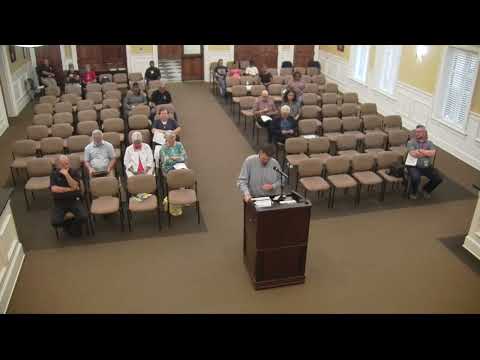
During public comment residents raised a handful of technical and site-specific questions. Todd Warner flagged a missing cross-reference in the fence section of the packet; Thompson confirmed it was a dropped section number. Judy Peavy asked whether apartment or townhouse developments change runoff to adjacent yards; Thompson said stormwater controls remain governed by the development code and regional/state standards and that the update did not change the main stormwater requirements.
After discussion, Councilmember (mover) made a motion to approve UDO 26-01. The mayor called the vote and the amendment passed 6–0. Council members thanked the planning department for the technical work and urged residents with parcel-specific concerns to follow up with staff.
The council’s adoption takes effect per the city’s effective-dates rules in the ordinance; implementation details and any needed administrative forms will be handled by the planning department.