Get Full Government Meeting Transcripts, Videos, & Alerts Forever!
Get email alerts on the Superintendent Search topic
No spam. Unsubscribe anytime.
Marty McRae says "people make the difference," emphasizes hiring, growth planning and special-ed process in superintendent interview
Summary
Assistant superintendent Marty McRae told the Baldwin County Public Schools board he would prioritize hiring the right leaders, strengthen early RTI interventions before special-education evaluations, and plan multi-year responses to district growth if selected superintendent.
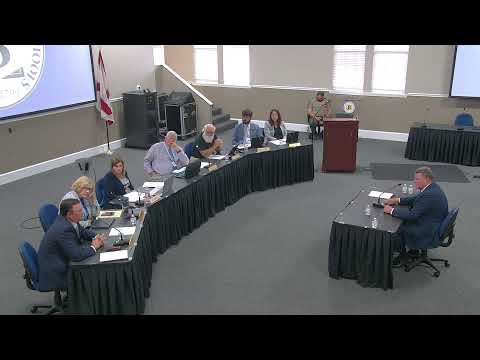
Marty McRae, assistant superintendent and a candidate for superintendent of Baldwin County Public Schools, told the board in a candidate interview that his top priority would be people — placing the right leaders and staff in both schools and central office to support students.
"Every school system's ever had is all gotta be about one thing, that's children," McRae said, adding: "People make the difference." He told the panel he would begin by ensuring the district has assistant superintendents, curriculum leaders, and operational staff such as transportation and maintenance to support classroom work.
Why it matters: Baldwin County faces fast population growth and complex budget and staffing choices. McRae said the district needs a multi-year plan — three to five years — to address where new schools and rezoning will be required as enrollment shifts.
Detail and priorities McRae said early intervention in behavior and academics is essential before a student advances to a formal special-education evaluation under federal law. "RTI is not just academics," he said. "It also deals with behavior." He described response-to-intervention teams that include parents and school staff, and said those interventions can avert later escalation; if testing shows eligibility for special education, the district then follows IDEA requirements and develops a behavior intervention plan (BIP) when needed.
On staffing and accountability, McRae said the district must be willing to make changes when roles or performance do not meet student needs: "If we don't have the right people there, then we have to change it." He proposed governance processes and multi-year timelines to measure incremental change so the board and superintendent can track progress without abrupt turnover that could produce pushback.
Technology, advanced learners and data Board members asked about the district's one-to-one device program and concerns about screen time and mental health. McRae described technology as integral to students' lives and useful in collaborative classrooms but cautioned it "cannot replace good teaching." He recommended annual review of technology use and clear expectations for when it's an instructional tool rather than a substitute for in-person teaching.
On advanced learners, McRae pointed to an expanded Advanced Placement and dual-enrollment program that extends into ninth grade and partnerships with local colleges; he said some students finish high school with significant college credit.
Budget and operational constraints McRae framed the district as a large organization with personnel driving costs — he said roughly three-quarters of the budget is personnel — and described routine reviews to eliminate duplicative programs (citing ParentSquare as one example of consolidation). He warned that adding personnel to reduce classroom paperwork is costly and that federal and state documentation requirements constrain shortcuts, especially in special education.
School closures and growth planning When asked about worries that closing Perdido Middle School could conflict with North Baldwin economic development, McRae said the conversations were preliminary and that "nothing will ever happen without you guys agreeing" and legal review. He emphasized the board must approve major changes and that the district should align feeder patterns and capital projects to projected growth.
Mental health and outside services On student and staff mental-health needs, McRae said the district is not a mental-health provider; counselors and social workers triage crises and the system refers families to outside professionals when appropriate. "Our job's main job is the education portion of it," he said, adding that referral to outside agencies, including DHR when necessary, is part of the process.
Next steps McRae closed by thanking the board for the opportunity to interview and by reiterating his commitment to Baldwin County schools if chosen. The board did not take action at the interview; next procedural steps in the search were not announced during the session.