Get Full Government Meeting Transcripts, Videos, & Alerts Forever!
Get email alerts on the Mining And Environment topic
No spam. Unsubscribe anytime.
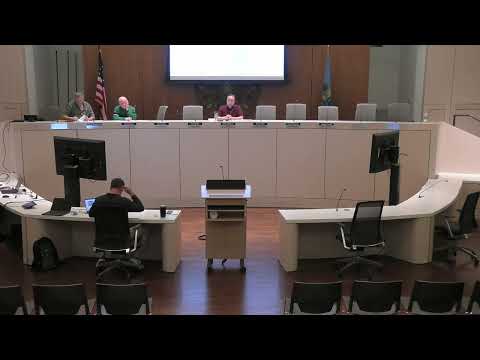
Bonner Springs hearing on APAC quarry permit draws residents alleging foundation damage, consultant reports blasts under safety limits
Summary
At a Feb. 25 public hearing on APAC’s SUP0125 renewal, multiple Bonner Springs residents said quarry blasting has damaged foundations, created dust and prompted low helicopter flights; VibraTech presented seismograph data showing recorded blasts were well below U.S. Bureau of Mines safe‑blasting thresholds, and APAC said it does not schedule helicopter or train operations because it owns mineral rights but not the surface.
Dozens of Bonner Springs residents urged the Planning Commission Feb. 25 to deny or place strict conditions on a special use permit renewal for an APAC quarry, saying repeated blasting, dust and low helicopter flights have damaged homes and disrupted daily life. APAC and an independent vibration consultant said monitoring shows blasts remained below established safety thresholds.
Julia Parker, who lives at 12520 Kansas Avenue, told the commission she and her family spent more than $43,000 to install foundation piers after apparent foundation movement and then roughly $30,000 on siding repairs. "We're in 70 plus thousand dollars to fix our home," she said, attributing the damage to blasting that began in 2019. Parker also said helicopters frequently pass low over her house, often at night.
Several nearby homeowners gave similar accounts of cracked concrete, rattled walls and persistent dust. Mark Hopkins of 12348 Kansas Avenue said the blasts "shake the **** out of you," and Josh Pittman of 12300 Kansas Avenue said patio and retaining-wall cracking and constant dust have been ongoing problems since construction of his home.
APAC Kansas environmental permit manager Dan Jones told the commission APAC owns the mineral rights at the site but not the surface property, which is owned by Waste Management, and that APAC does not schedule train operations or helicopter flights. "We do not have anything to do with the train operations," Jones said; he added APAC has been negotiating to purchase the property from Waste Management and said the company would work on notification or scheduling if it obtained surface ownership.
Bobby Hippenbecker of VibraTech Engineers summarized seismograph monitoring from Jan. 1, 2024, through Feb. 10, 2025. VibraTech deployed five seismographs around the quarry and reported that 95 blasts triggered monitors during the period; highest measured blast levels at individual monitors were reported as percentages well below the U.S. Bureau of Mines' safe-blasting limits (examples cited by the consultant included readings at 36.67%, 19.79%, 15.94%, 14.71% and 12% of the USBM thresholds). Hippenbecker said air-overpressure readings also fell below the state limit and concluded, "there isn't any indication that there would be any damage caused by the blasting," while acknowledging that blasts can rattle structures and be upsetting to residents.
At the outset of public comment, Commissioner Paul Zeps announced he would recuse himself from the hearing because his property shares a large boundary with the quarry and, while speaking as a resident he asked the commission to add two stipulations to any renewed permit: require 48 hours' public notice posted online for any rail operations that will block Highway 32, and prohibit helicopter/aerial training and other aerial operations from using the site. Zeps recommended escalating consequences for violations (a multi-day suspension for a first violation and revocation for repeat violations).
Residents also asked the city to provide independent monitoring: Cindy George requested that the city place its own seismograph on her property and share readings with neighbors. Neighbors asked whether air-quality testing has been done to quantify dust impacts.
Technical contractors answered commissioners' questions about blast design and limits. A contractor explained that blast size and vibrations vary by bench depth (reported range in discussion: five to 23 feet) and by the number of holes timed per delay; a hard upper cap was mentioned in discussion as about 18,000 pounds per blast truck capacity, but the consultant emphasized that particle velocity and frequency, not an absolute explosive weight, determine the risk of structural damage.
The commission did not vote on SUP0125 during the meeting. The public hearing opened at 6:48 p.m.; after presentations and public comment the chair called a brief recess. No final action was recorded in the transcript provided.
What happened next: the hearing was left open when the meeting recessed and the record shows APAC representatives and an independent consultant will provide data and answer follow-up questions; any future recommendation or vote will follow the commission's continued review and statutory notice requirements.