Get Full Government Meeting Transcripts, Videos, & Alerts Forever!
Get email alerts on the Early Childhood Help Me Grow topic
No spam. Unsubscribe anytime.
KDHE and partners expand Help Me Grow Kansas access through 1-800-Children and pilot screening events
Summary
KDHE and partners described Help Me Grow Kansas'a system-building model centered on a statewide centralized access point, 1-800-Children'which offers 24/7 phone, text, email, web and app support and will pilot PDG-funded Books, Balls and Blocks screening events with ASQ completion and follow-up referrals.
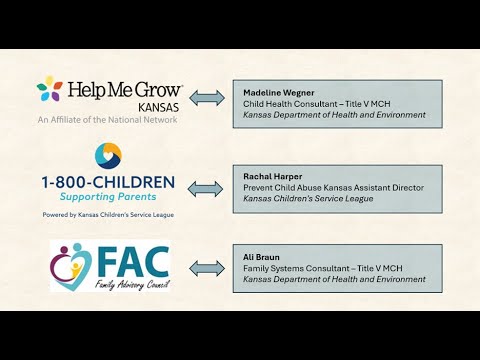
Madeline Wagner, child health consultant at the Kansas Department of Health and Environment (KDHE) and state lead for Help Me Grow Kansas, described Help Me Grow as a system-building framework that connects families to services across health care, early childhood and community supports.
"Help Me Grow is a framework designed to promote the healthy development of young children by connecting families to the right services and supports they need at the right time," Wagner said, outlining four core components: family and community outreach, provider outreach, a centralized access point, and data collection and analysis.
Wagner and partner organizations said Kansas'centralized access point is 1-800-Children, a statewide service staffed by Kansas Children's Service League (KCSL) personnel. Rachel Harper, assistant director at KCSL, said 1-800-Children provides "judgment-free support" around the clock and is available by phone, email, text, website and mobile app. "Our 1-800-Children team is made up of a supervisor and one family resource specialist in our Topeka office," Harper said, noting additional staff in Wichita and bilingual coverage.
Harper described the underlying resource database (built and maintained via the Find Help platform) as searchable by ZIP code, offering provider cards that list services, eligibility and contact details, and features that let providers "claim" a program to enable referrals and let families suggest programs for verification. She said the database currently lists more than 5,400 resources and that Find Help''which KCSL partners with''maintains a team to verify and update listings regularly.
Harper shared 2024 service metrics for 1-800-Children: 1,618 total calls, 35,021 interactions (visitor activity indicating information-seeking), and 3,323 connections where a user clicked to contact a program. She said the top call reasons were program information, utility assistance, and child abuse and neglect concerns; the top searches were housing assistance, mortgage/rental assistance, and parenting classes.
Wagner and Harper also outlined Books, Balls and Blocks, a Preschool Development Grant-funded (PDG) event model to increase screening access. The events will allow families to complete the Ages and Stages Questionnaire (ASQ) on site, receive printed and electronic copies of results, and get a take-home kit with developmental resources and books from Dolly Parton's Imagination Library. "After completing the screening, based on the screening results, 1-800-Children can help connect families to appropriate services," Wagner said.
Harper noted that through 1-800-Children staff have offered ASQ screenings since spring 2022 and can complete screenings entirely over the phone if callers prefer. KDHE expects to pilot Books, Balls and Blocks with a small set of childcare partners in the first year and expand partnerships in year two, which begins Oct. 1.
Wagner said KDHE will add a physician champion to the Help Me Grow core team in summer 2025 to support development of training for clinical settings; the team aims to make developmental-screening trainings available to health providers by the end of 2025.
The presenters encouraged providers and community groups to claim programs on the resource database, order promotional materials, and sign an interest form (posted in the webinar chat) to pilot Books, Balls and Blocks or receive provider outreach. The Help Me Grow team said it is working with the Family Advisory Council to strengthen search results and embed family input in system design.
The Help Me Grow materials, the 1-800-Children contact options, and the resource database are publicly available; program addition and verification are handled by the Find Help team, which reviews listings for updates at least every six months.
Next steps: KDHE plans quarterly reporting of Help Me Grow fidelity data with an eventual public dashboard, the physician champion will onboard in summer 2025, and Books, Balls and Blocks year two will begin Oct. 1. Providers interested in participating were asked to complete the interest form shared in the webinar chat.