Get Full Government Meeting Transcripts, Videos, & Alerts Forever!
Get email alerts on the Advocacy topic
No spam. Unsubscribe anytime.
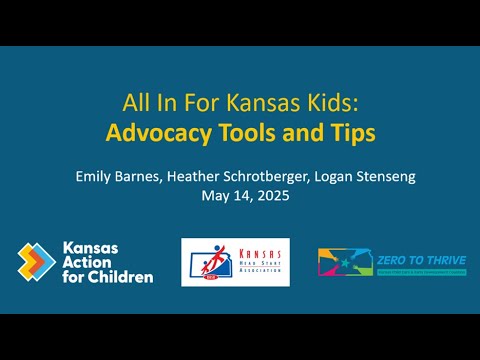
Advocates at Children’s Cabinet webinar urge Kansans to share stories, build relationships to influence early-childhood policy
Summary
Presenters from Kansas Action for Children, the Kansas Head Start Association and Thrive Kansas urged parents and providers to use storytelling, relationships, and targeted asks to influence state and federal decisions affecting early childhood services.
Emily Barnes, education policy adviser at Kansas Action for Children, opened a May 14 Children’s Cabinet “All in for Kansas Kids” webinar by framing advocacy as a means for people with limited voice to influence public policy. "Advocacy is a public support for or recommendation of a particular cause or policy," she said, and encouraged attendees to consider what changes they want to see and who can help make them.
Barnes walked participants through the Kansas legislative calendar and committee process, emphasizing that Kansas’s part-time, 90-day legislature concentrates action between January and May and that committees are pivotal places for testimony and amendments. She urged attendees to use the legislature’s website to track bills, committees and videoed hearings and recommended joining nonpartisan partner newsletters for plain-language summaries.
Heather Schroetberger, executive director of the Kansas Head Start Association, described how Head Start programs build parent leadership through required parent policy councils. She said federal law gives those councils roles beyond advisory input, including participation in governance and fiscal decision-making. "When parent and family voice is centered, valued and prioritized, research demonstrates benefits to children, to families, and to the programs," Schroetberger said, noting that about 20% of the Kansas Head Start workforce are current or former Head Start participants.
Logan Finzing of Thrive Kansas laid out concrete steps for building advocacy power: register and mobilize voters, engage local officials (who often shape zoning and local funding), and connect with state and federal lawmakers. He emphasized concise storytelling—preparing a 30-second elevator pitch—and always ending outreach with a clear, specific ask. "If you visit a bill and you see the total vote count, you can click on that, learn where they stood," Finzing said, urging participants to use testimony calendars to see proponent and opponent lists and identify allies.
Presenters repeatedly recommended working in coalitions, staying connected to advocacy partners, and balancing effort with self-care. The session closed with offers of follow-up contacts and resources from the presenters.
Next procedural steps: presenters encouraged attendees to sign up for partner newsletters, use the legislative website and testimony calendars during session, and consider contacting the presenters directly for localized presentations or support.