Get Full Government Meeting Transcripts, Videos, & Alerts Forever!
Get email alerts on the Zoning topic
No spam. Unsubscribe anytime.
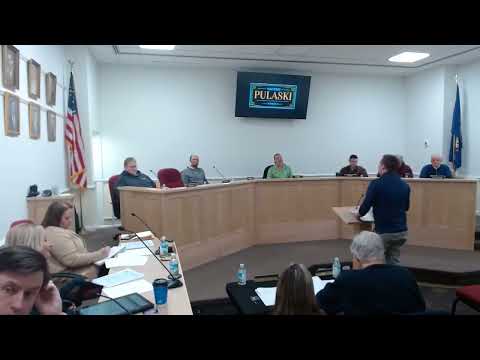
Pulaski council previews plan to allow permanent farm stores in rural residential zone
Summary
At its March 3 meeting the Pulaski Town Council heard a presentation from consultant Steve Snowys of Westwood on a proposed zoning text amendment to permit permanent farm stores in the rural residential district, including proposed product‑origin limits, building‑size caps and parking exceptions; the proposal will return for review at the planning commission and a public hearing.
The Pulaski Town Council on March 3 heard a preview of a proposed zoning text amendment to allow permanent farm stores in the town’s rural residential (RR) district.
Steve Snowys of Westwood told the council Pulaski currently lacks a distinct agricultural zoning district and that the draft language would add standards for product origin, building size, setbacks and parking. “Town of Pulaski doesn’t have an agricultural zoning district,” Snowys said, and the draft borrows a 75‑mile origin limit from the town’s existing farmers‑market rules.
The consultant said the draft sets a 4,000‑square‑foot cap for building size—reduced from the 5,000 square feet he observed in other localities—and includes parking‑surface exceptions for farm markets where appropriate. Snowys said mapping shows most RR parcels clustered on the town’s southeast side and that the property prompting the request lies on the north side; if the council supports the change the applicant may later seek rezoning of a specific parcel.
Council members pressed for clarity on details. One member asked, “Where does that number come from?” about the 75‑mile standard; Snowys said it mirrors the town’s farmers‑market rule. The same member questioned whether 4,000 square feet is unusually large for a farm stand; Snowys said other localities use 5,000 and he would accept council and planning commission recommendations.
Another council member said some long‑time residents near the north‑side property oppose locating a farm store there and added, “I’m not for it,” unless persuaded otherwise. Several council members stressed that any property‑specific rezoning and the policy question about RR‑1 use should be handled as separate steps and that adjoining property owners must be notified if rezoning is proposed.
The town manager asked the consultant to brief the planning commission before a formal application is filed; Snowys said the firm will present a fuller package at that public hearing and work with staff to refine the draft language.
Next steps: planning commission briefing, public hearing, then potential council consideration of specific rezoning applications.