Get Full Government Meeting Transcripts, Videos, & Alerts Forever!
Get email alerts on the Affordable Housing topic
No spam. Unsubscribe anytime.
Laguna Beach approves $6.7 million package to advance 29‑unit affordable housing at Saint Anne’s Drive
Summary
The city council unanimously adopted three actions authorizing a revised funding commitment to support a 29‑unit affordable housing project on land leased from Neighborhood Congregational Church, approving a $6.71 million local package that includes a $2.5 million HCD award, a $2.5 million city match and up to $740,000 in fee waivers.
Laguna Beach — The City Council on July 15 unanimously approved a staff‑recommended funding package totaling about $6.71 million to help finance a 29‑unit affordable housing project at 340 Saint Anne’s Drive, a development that will preserve church property and add 28 income‑restricted homes.
City staff told the council the project, to be developed by Related, would include 28 restricted units and one manager unit, a subterranean garage with 41 parking stalls and about 30,000 square feet of new construction on land leased from Neighborhood Congregational Church (NCC). Staff said the package is built around a $2.5 million Housing and Community Development (HCD) award that requires a $2.5 million local match and includes up to $740,000 in fee waivers. The revised proposal trims the developer’s original $8.25 million request to the recommended $6.71 million through deferrals, fee waivers and a reduced gap loan structure.
Why it matters: staff emphasized that the site is identified in the city’s housing element and producing affordable units there affects Laguna Beach’s RHNA inventory and compliance with state housing law. Staff said failing to develop identified sites can trigger state-mandated reallocation of units and reduce local control over future rezoning decisions.
Project details and financing: staff described the capital stack as relying primarily on tax credit financing, a bank loan and public gap funding. The 28 income‑restricted units break down as nine extremely low‑income, three very low‑income and 16 low‑income units, with one unrestricted manager unit. Staff said Related’s TCAC (tax credit) application deadline is July 21; if the project secures credits, the city’s assistant city manager or designee and the city attorney will negotiate loan documents and a regulatory agreement to preserve affordability for 55 years. Staff also proposed purchasing the construction cost for six surplus parking spaces (estimated at about $523,000) as part of a strategy to produce a modest revenue stream for the city and reduce direct cash assistance.
Public comment: testimony at the emergency meeting was sharply divided. A resident who identified themself only as a local opponent urged the council not to “abuse taxpayer dollars,” arguing the city had no legal obligation to fund the project and that the loan terms were onerous. “We are not legally obligated to fund these projects. Period,” the resident said. By contrast, multiple residents and housing advocates said the city faces legal and practical consequences if it fails to facilitate housing on inventory sites. Michelle McCormick, a Laguna senior, told the council the developer had scaled back the project in response to neighborhood concerns and urged approval. Several speakers cited local workers who commute long distances and backed the project as an investment in Laguna’s economic and community fabric.
Historic preservation and church commitments: Pastor Rod of Neighborhood Congregational Church told the council the church intends to retain the historic buildings and will submit future permit applications for any remodels rather than making unilateral changes. He estimated a minor remodel of the church buildings could cost roughly $6–7 million and said the congregation is mindful of future generations and not inclined to encumber successors unnecessarily.
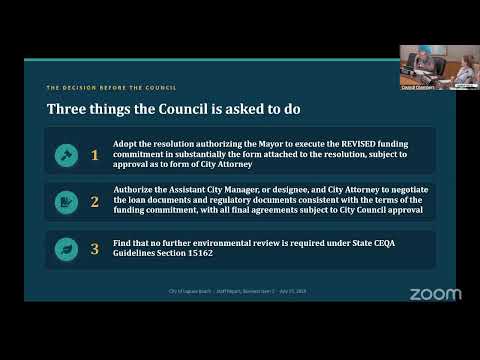
Council action and next steps: Council member Whelan moved the three staff‑recommended actions — adopt a resolution authorizing the mayor to execute a revised funding commitment letter, authorize the assistant city manager/designee and city attorney to negotiate loan and regulatory documents, and find no further environmental review is required — and Council member Kemp seconded. The council voted unanimously to approve the measures. The staff presentation and redlined funding commitment (disbursement timing, expiration and list of fees eligible for waiver) were incorporated into the motion. Staff will return with negotiated loan documents and the regulatory agreement if Related secures tax credits.
Fiscal and process questions raised: commenters and some council members pressed for additional transparency on the project’s cost breakdown, the $3.6 million acquisition/lease amount, the residual receipts loan structure (noted in staff material as a long‑term receivable), developer fees and how priority will be given to local applicants. City staff and the ad hoc committee said the recommended package limits immediate city cash exposure by using fee deferrals and restricted housing funds and that the independent consultant Kaiser Marston Associates reviewed pro forma assumptions and confirmed feasibility.
Outcome: the council approved the funding commitment package and directed staff to finalize loan and regulatory documents if the developer secures tax credits on or after the upcoming TCAC application round. The council’s action preserves a path for construction to begin after financing and regulatory agreements are executed.