Get Full Government Meeting Transcripts, Videos, & Alerts Forever!
Get email alerts on the Kinship Care topic
No spam. Unsubscribe anytime.
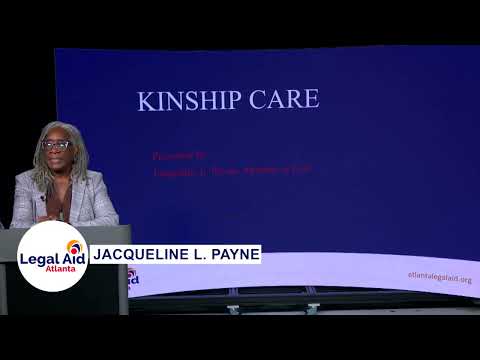
Atlanta Legal Aid attorney Jacqueline Payne outlines custody options and benefits for kinship caregivers
Summary
Jacqueline Payne of Atlanta Legal Aid described legal paths — from power of attorney to adoption — and available public benefits (TANF, SNAP, WIC, GRG), plus resources and a hotline for relatives caring for children not living with their birth parents.
Jacqueline Payne, the managing attorney for Atlanta Legal Aid’s Kinship Care Project, outlined legal options and public benefits available to relatives and other nonparent caregivers who are raising children not living with their birth parents.
Payne said the program grew from a late‑1990s “Grandparents Project” after staff saw many relatives seeking help getting custody. "Our goal is to provide attorneys and non attorneys with the basic skills and knowledge to assist and provide helpful information for those who are non parent caregivers of minor children," she said, explaining that Atlanta Legal Aid offers statewide advice and direct representation in five Metro Atlanta counties and refers other callers to Georgia Legal Services.
Payne walked through custody options from least to most restrictive. She described a kinship power of attorney — now framed by Georgia’s Supporting and Strengthening Families Act — as a temporary document that can be filed in probate court; she said non‑grandparent caregivers are limited to one‑year powers of attorney while grandparents may receive broader timeframes under the statute. "It's a legal document, of course. It's not a letter," Payne said, noting it must follow form requirements at the county probate court.
She described temporary guardianship as a next step: parents may revoke it by petitioning probate court, and contested revocations are often transferred to juvenile court for further review. Payne said permanent guardianship is available only when a legal parent is deceased or parental rights have already been terminated; otherwise a temporary guardianship typically remains in place until the child turns 18 unless a parent successfully revokes it.
Payne explained deprivation petitions in juvenile court — often involving the Department of Family and Children Services (DFCS) — and private deprivation actions that relatives can file. She emphasized juvenile courts generally pursue reunification when feasible and may require services, testing and oversight while parents work toward reunification.
For caregivers who cannot or do not want guardianship, Payne described third‑party custody actions in superior court. Those cases have a higher legal standard and are generally limited to certain relatives (grandparents, aunts and uncles, first cousins, great‑grandparents); a caregiver must show the custody award is in the child’s best interest or that the parent is unfit. "If you can show a long established bond with the child," she said, the court is more likely to grant custody.
At the far end of the spectrum, Payne discussed termination of parental rights and adoption. She said Georgia law gives a parent a short period (four days) to revoke a signed surrender and that adoption can change a child’s and caregiver’s eligibility for benefits, so caregivers should weigh emotional as well as practical effects.
Payne reviewed public benefits that may help caregivers. She said Temporary Assistance for Needy Families (TANF) can be applied for on a child‑only basis (so household income may not be counted) and that Medicaid coverage typically accompanies those benefits. She described the GRG (Grandparents Raising Grandchildren) supplement as an additional payment for eligible grandparents — "it's only $100 per child per month," she said — and discussed a one‑time crisis intervention payment for emergencies (amount and multiplier were described in multiple ways in the presentation). Payne also explained SNAP eligibility is household based and requires the caregiver to show relationship to the child, while WIC can provide supplemental nutrition for young children if the caregiver is income‑eligible. She cautioned that some benefits require legal guardianship or custody orders to qualify.
Payne advised caregivers on housing and school enrollment: subsidized housing programs typically require proof of legal custody to add a child to a lease, and schools must enroll children without full documentation under the McKinney‑Vento Act when a child is homeless or lacking parental/legal guardianship; most districts now use a one‑page affidavit for enrollment and special education services (IEPs) continue regardless of custody status.
For help, Payne directed listeners to probate court forms at georgiaprobate.org and to state kinship navigators who assist caregivers in accessing programs. She said family law information centers operate in Metro counties including Cobb County, Fulton County and DeKalb County, and provided Atlanta Legal Aid’s kinship care hotline: "This is a 24 hour a day, 7 days a week answering service," she said. "Call (855) 357-6566; leave a message and someone will return your call within 24 to 48 hours."
The presentation focused on practical next steps for caregivers — identifying which legal route fits a family’s circumstances, the paperwork and court venues involved, and the benefits that may be available — and concluded with resources for individualized legal help.