Get Full Government Meeting Transcripts, Videos, & Alerts Forever!
Get email alerts on the Mediation topic
No spam. Unsubscribe anytime.
Atlanta Legal Aid attorney Katie Mayo outlines how to prepare for mediation in Cobb County
Summary
Katie Mayo of Atlanta Legal Aid offered a practical primer on mediation for Cobb County family-law cases: what mediation is, the mediator's neutral role, required domestic-violence screening, what to bring, fee rules (typically split 50/50), waiver options for low-income clients, and local resources.
Atlanta Legal Aid attorney Katie Mayo gave an informational presentation on preparing for mediation in Cobb County, explaining who mediators are, what to bring, cost and safety considerations, and where residents can get local help.
Mayo said mediation — also called alternative dispute resolution or ADR — is a confidential process in which a neutral third party helps disputing parties negotiate a settlement and avoid trial. "A mediator is a trained and certified person to help you and the other side communicate," she said, adding that mediators are meant to facilitate negotiations and not to advocate for either side.
The presentation emphasized practical preparation. Mayo advised parties to be on time, bring an attitude of compromise and a written plan for what would constitute a good outcome, and bring all relevant documents (financial statements, proposed child-support worksheets, parenting plans and other evidence) in paper or digital form. "If you've been ordered to mediate by a judge, you are required to participate in good faith," she said, but she noted that parties are not required to sign a settlement agreement during the mediation session.
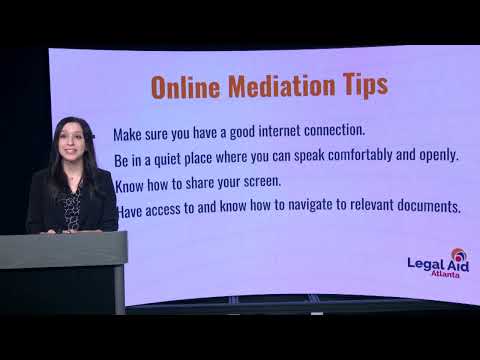
Mayo described how typical mediations proceed: introductions and mediation guidelines, confidentiality information, and caucuses (private meetings between the mediator and one party) followed by offer exchanges. She warned that mediators will assess whether parties are near settlement and may suggest breaks or end the session if resolution appears unlikely. Participants should know how to share screens and access documents in advance to avoid wasting paid mediation time on technical issues.
On cost, Mayo said mediators generally charge an hourly fee — often similar to attorney billing rates — and that costs can rise if a session runs long; parties typically split the mediator's fee 50/50. Low-income clients can apply for a fee waiver through the Cobb ADR program, but Mayo recommended applying early because processing times vary.
Safety procedures for family-law mediations were highlighted. Mayo said domestic-violence screening is required in Cobb County family-law cases to assess threats and prioritize safety; if safety concerns exist, mediations may be arranged online or otherwise modified to protect participants.
She noted partial settlements are possible and sometimes advisable — for example, resolving custody or parenting-plan issues while reserving property division for later. When agreements are reached, the mediator can draft terms for both parties to sign; Mayo advised reading any settlement carefully and obtaining a signed copy before leaving the session because changes afterward can be difficult.
For Cobb residents seeking assistance, Mayo gave Atlanta Legal Aid's centralized intake number, 404-524-5811 (Monday–Thursday, 9 a.m.–11 a.m.), recommended the Cobb Courthouse Law Library walk-in consultations (staffed three days a week by Atlanta Legal Aid attorneys) and provided the Cobb ADR program phone number, 770-528-1812, and relevant online resources including georgialegalaid.org.
The presentation was informational and did not constitute legal advice; Mayo encouraged anyone needing case-specific counsel to contact an attorney.