Get Full Government Meeting Transcripts, Videos, & Alerts Forever!
Get email alerts on the Data Centers topic
No spam. Unsubscribe anytime.
Planning Board to hold hybrid public hearing on county data-center study; staff recommend restrictive rules for hyperscale facilities
Summary
The Planning Board set a hybrid public hearing for Sept. 3 on a staff draft of the data-center study (Council Bill 3-26). Staff recommended a restrictive approach focused on hyperscale facilities (25 MW+), limiting locations, requiring conditional approvals, and emphasizing water, noise and equity concerns.
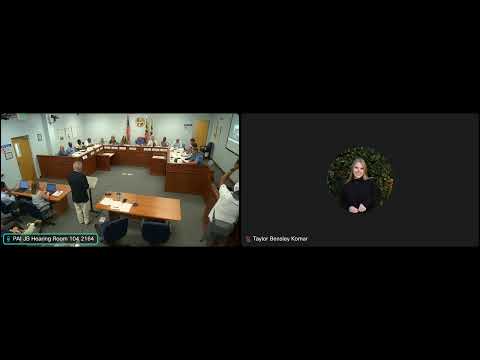
The Baltimore County Planning Board voted on July 16 to schedule a hybrid public hearing for Sept. 3 on the county’s draft data-center study, a report prepared in response to County Council Bill 3-26 and produced by an interagency work group.
Steve Lafferty, director of the Department of Planning, introduced the draft report and said it concentrates on hyperscale data centers (those the state defines as 25 megawatts or larger). The report — posted online — summarizes the nature of data centers and permitting processes, compares average electricity and water use, and analyzes potential tax revenue and economic benefits. Lafferty said the report’s recommendations will be delivered to the County Council by Oct. 1, per the bill’s timetable.
Key recommendations in the draft: staff advise that data centers not be allowed by right; instead, the county should rely on special exceptions or conditional approvals. The report proposes limiting locations (favoring industrial or M zones rather than residential settings), requiring safeguards for proximity to residences and protections for underserved or overburdened communities, restricting incentives, and increasing opportunities for public engagement. The study highlights three core impact areas: water use, electricity demand (which the county cannot regulate directly), and noise.
Board members asked technical questions about how the report classifies data-center sizes (by megawattage and square footage), whether water or backup fuel (diesel or batteries) were included in consumption figures, and how a tiered regulatory system might distinguish smaller facilities from hyperscale operations. Lafferty said the report focuses chiefly on the larger facilities that the public identified as the greatest concern, noted that public works will evaluate site-specific water capacity and pressure zones, and recommended closed-loop cooling where water impacts are a priority.
The board voted to set a hybrid public hearing for Sept. 3 at 5 p.m. to receive public testimony on the report. Lafferty said staff will send additional materials and correct any broken links in the posted materials before the hearing.
Next steps: public hearing Sept. 3; County Council will receive the final report by Oct. 1 as required by Bill 3-26.