Get Full Government Meeting Transcripts, Videos, & Alerts Forever!
Get email alerts on the Transportation topic
No spam. Unsubscribe anytime.
AECOM finds downtown two-way conversion operationally feasible; board weighs WisDOT timing and public input
Summary
An AECOM traffic study presented to the Stevens Point Board of Public Works found converting parts of downtown from one-way to two-way streets is operationally feasible; the city will weigh partnering with WisDOT on a possible State Highway 66 reconstruction in the early 2030s and pursue public engagement before deciding.
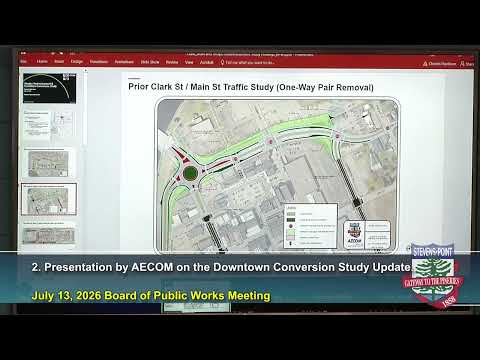
Derek Solomonson, the AECOM project manager and lead traffic engineer, told the Stevens Point Board of Public Works on July 13 that a traffic-impact analysis of 11 downtown intersections shows existing operations and modeled future conditions are generally acceptable and that a limited one-way-to-two-way conversion of the downtown area could work operationally.
“The operations were deemed or found to be acceptable under existing conditions, and into the future no-build conditions as well acceptable,” Solomonson said, summarizing the study’s core finding about AM and PM peak performance. He described a suite of feasible design options the study considered, including a single-lane roundabout at Clark and Water streets (or signalization), a proposed Smith Street extension that would require new right-of-way and property acquisition, conversion of select one-way streets to two-way, and reconfiguring CenterPoint Drive — currently carrying a State Highway 66 designation — which would require coordination at the state and federal levels.
The AECOM presentation included modeling for future years (2035, 2045, 2055) that combined modest background growth and trip generation from proposed multifamily and mixed-use redevelopment. The consultant said most intersections remain at level-of-service A–C in the scenarios tested and that only isolated PM-peak movements showed notable delays in the long-term build condition.
Board members asked whether doing nothing would leave traffic functioning adequately. Solomonson replied yes for operations, and the board debated whether large capital expenditures are warranted for limited operational gains. One committee member said, “If we partner with the Department of Transportation, spend a crap ton of money, redesign everything, it will be okay,” arguing the operational benefit may be marginal compared with the cost.
Several members emphasized the need for additional analysis beyond traffic metrics. Alder Jackie Guthrie said the AECOM presentation focused on traffic feasibility but did not address downtown vibrancy, cost-versus-revenue analysis, or short-term harm to businesses from major construction. Alder Andrea Olsen suggested the board consider very targeted, low-cost changes (for example, extending specific local streets or adjusting lane widths) that might achieve some benefits without full reconstruction.
City staff and AECOM noted WisDOT is preliminarily programming a State Highway 66 reconstruction in the early 2030s (the city’s director said the state tentatively referenced 2032). Staff said aligning city planning with that timeline could reduce duplicate design and construction costs and that the next step, if the board is interested, would be a public-engagement process to gather community and downtown business input before formal design or commit to partnering with WisDOT.
The board did not take final action on the study; members asked staff to return with opportunities for public involvement and to revisit the question after soliciting downtown and constituent feedback.