Get Full Government Meeting Transcripts, Videos, & Alerts Forever!
Get email alerts on the Financial Strategy topic
No spam. Unsubscribe anytime.
Coppell staff outlines long‑term financial strategy and proposes $5 million transfer to infrastructure fund
Summary
City finance staff framed a strategy of conservative revenue assumptions, reserves and targeted transfers; staff proposed up to $50,000 in HOT marketing support, a $5,000,000 transfer to the Infrastructure Maintenance Fund, and a $250,000 transfer from the cemetery fund to the general fund.
City staff presented a multi‑year financial strategy to the Coppell City Council on July 14, outlining conservative revenue assumptions, reserve targets and targeted transfers to support infrastructure and mandated programs.
Finance staff member Kim told council the presentation was about “investing in Coppell’s future,” stressing conservative budgeting for sales tax and interest income amid economic uncertainty and the use of a five‑year forecast to guide policy. Kim said the city treats unexpected one‑time revenues as strategic capacity rather than ongoing operating revenue and emphasized preserving fund balance to absorb future pressure.
Staff reviewed several special revenue funds. Mr. Collins highlighted the hotel occupancy (HOT) fund — generated at the 7% occupancy rate — and said the city could use HOT revenues for one‑time marketing support of resident arts organizations, recommending not to exceed $50,000 initially. Collins also said the municipal drainage utility (DUD) is under pressure as stormwater needs and repair projects outpace revenues and noted a DUD rate study is forthcoming.
On infrastructure, Kim and Collins cited past transfers (about $31,000,000 moved previously into the Infrastructure Maintenance Fund) and said the fiscal‑year 2026 budget includes a $5,500,000 transfer to the municipal drainage utility for drainage projects. Staff proposed an additional $5,000,000 transfer from undesignated fund balance to the IMF to address rising capital and facility costs, including street reconstruction, concrete panel replacement and fire station remodels.
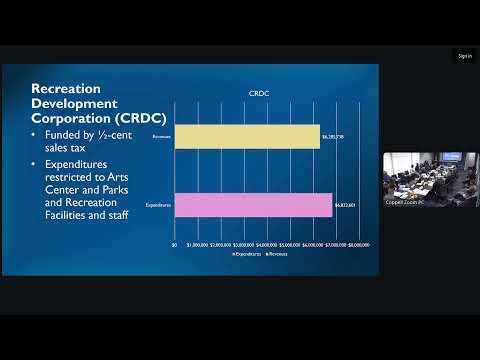
Collins also reviewed the Rolling Oaks Memorial Cemetery (ROMC) fund, recommending a $250,000 transfer from ROMC to the general fund to reimburse prior general‑fund expenses; staff said ROMC has sufficient revenues and fund balance for that transfer. Crime control and the CRDC (half‑cent sales tax for arts and parks facilities) budget items were reviewed with modest administrative updates and project lists (pool repairs, court resurfacing, wagon‑wheel wall replacement).
Council members asked detailed questions about revenue projections for hotels and whether additional rooms will generate proportional HOT revenue; staff said hotel operators provided revenue estimates used in projections. Staff listed three decision requests for council consideration: (1) up to $50,000 HOT marketing support for resident arts organizations, (2) a $5,000,000 additional transfer to the IMF from undesignated fund balance, and (3) a $250,000 transfer from ROMC to the general fund.
No formal votes were held; staff asked council for feedback and indicated the items will be revisited in work sessions and formal budget hearings.