Get Full Government Meeting Transcripts, Videos, & Alerts Forever!
Get email alerts on the Water Utility Budget topic
No spam. Unsubscribe anytime.
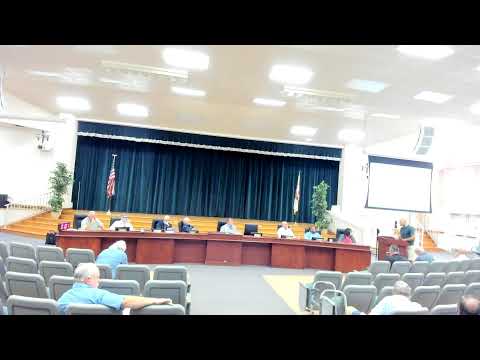
Columbia County reviews North Florida Water Utility Authority budget, debates $1 million revenue target and Fort White sewer concerns
Summary
County commissioners reviewed proposed and alternate budgets from the North Florida Water Utility Authority, including a three-column comparison and rate scenarios that would generate about $1 million (or a lower alternate). Commissioners and public commenters pressed for more data on Fort White wastewater feasibility, and the commission removed the item from tonight's agenda for further review.
Columbia County commissioners spent the evening reviewing proposed and alternate budget options from the North Florida Water Utility Authority and debating how much revenue to ask customers to provide versus continued county subsidies.
The utility authority presenter told the board the packet now shows three columns — current year, the authority’s proposed budget, and an alternate the authority prepared after board feedback — so commissioners could compare costs, rate impacts and reserves. “I just received an email today that the utility authority was awarded a $350,000 grant, and it’ll be provided to us through FDEP,” the agency official said, noting the grant would help plan septic‑to‑sewer conversions in a portion of the service area.
Why it matters: the authority must balance customer rates, county contributions and contingency reserves while it completes asset transfers, evaluates the potential Wellborn acquisition and prepares for new large customers. The alternate budget reduces the contingency from about 15% to roughly 12%, increases each county’s contribution modestly and lowers some proposed customer increases compared with the higher‑revenue scenario presented earlier.
An accounting consultant working with the authority walked through the numbers and the three‑column comparison. “I work, contractually with the water authority as an accounting consultant,” he said, and explained that the alternate holds ending cash near the beginning balance while balancing revenues and expenditures by trimming reserves and modestly increasing county contributions.
Board members pressed staff on the origin of the authority’s revenue targets. Commissioners asked why staff sought a revenue increase that would generate roughly $1 million more in customer revenue in one scenario and about $800,000 in the alternate. Several commissioners said the top scenario appeared to produce steep commercial increases in some service areas. The presenter and consultant said the consultant firm Raftelis builds the model from the authority’s objectives and inputs; staff then asked Raftelis to produce a rate structure to meet the chosen revenue target. “When they make the model, the model breaks years out. If you add in the DOT plant … it causes the forecast to break in the future,” the agency official said, describing why staff favored a cautious approach to modeling while assets and customer counts are in flux.
Commissioners also raised legal and procedural concerns: one member asked whether statutes require a 5% contingency minimum; the accounting consultant said he was not aware that a special district has a specific statutory contingency requirement and emphasized that the core legal duty is a balanced budget.
Public comment centered on Fort White’s wastewater project. Lonnie Harrell, a Fort White councilman, told commissioners that Fort White had not completed a formal feasibility or environmental study and that the town’s initial phases would start with relatively few connections. “If you tell [the consultant] that your objective is economic development, then they’re going to give you a different rate,” Harrell said, urging coordinated discussion among the county, the authority and the town. George Thomas, mayor of Fort White, said he believes published numbers can show a feasible path under some transfer scenarios but acknowledged leadership and communication challenges in the town’s process.
Procedural outcome: because backup materials and alternate numbers arrived late for some commissioners and questions remain about modeling assumptions and Fort White projections, staff and the chair agreed to remove the utility budget item from tonight’s agenda so the authority can finalize figures at its upcoming meeting and return with clarified information. A staff member said, “we’re gonna pull it from the agenda,” and the board did not take a vote on rates or county contributions tonight.
What’s next: the North Florida Water Utility Authority will present final rate options at its meeting on Monday; the county commission may revisit subsidy levels and any rate recommendation after reviewing full backup materials and the authority’s decision.
Sources: Public remarks and staff presentation at the Columbia County Board of Commissioners meeting (see timeline).