Get Full Government Meeting Transcripts, Videos, & Alerts Forever!
Get email alerts on the Eligibility Clarifications topic
No spam. Unsubscribe anytime.
ACL webinar answers common questions about eligibility, definitions and submissions for garden-accessibility prize
Summary
During a June 25 informational webinar, ACL officials clarified which gardens and populations qualify for the Cultivating Connected Community Prize, file-format and page‑limit rules, and examples (teaching gardens, private nonprofit gardens and retirement communities may qualify if they intentionally reach target populations). Applicants with questions were directed to cultivatingconnections@acl.hhs.gov.
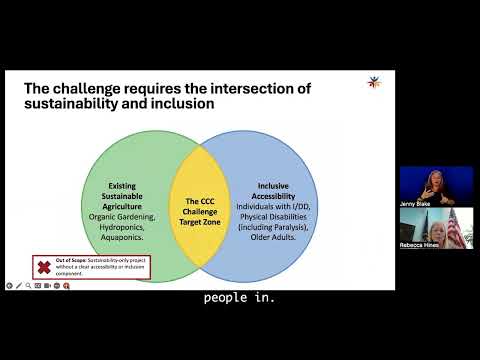
The Administration for Community Living fielded audience questions on June 25 about who may apply to the Cultivating Connected Community Prize and what counts as an eligible project.
Jennifer Johnson, Deputy Commissioner for the Administration on Disabilities, told attendees that existing gardens with at least one sustainable feature are the intended applicants and that projects already in process may or may not qualify depending on how far along they are. "If one's in process, I think there would have to be an understanding of sort of what degree are things in process," she said, and recommended sending a follow-up question by email so staff can provide a definitive response.
On specific examples, the agency said teaching gardens that are not exclusively for food production can qualify, and private nonprofit gardens and independent retirement‑community gardens can be eligible if they intentionally reach populations the garden has not previously included. Rebecca Hines, Commissioner of the Administration on Disabilities, emphasized outreach: applicants must show how they will reach people with disabilities and older adults who have not been participating.
Definitions and target populations
The webinar clarified the disability definitions used for this competition. The agency said it is using definitions tied to the funding statutes: the Developmental Disabilities Assistance and Bill of Rights Act (commonly discussed as "DD" but functionally including intellectual and developmental disabilities such as autism) and the Christopher and Dana Reeve Paralysis Act for paralysis definitions. Johnson said the DD definition is functional and can include autism; the competition includes older adults (including those living with dementia) as a priority population when applications are broadly inclusive of other disability groups.
Other Q&A highlights
- Substance‑use disorders and people experiencing homelessness may be included in outreach and participation plans, but the competition’s stated priority populations are people with disabilities and older adults. - The agency reiterated that federal grant or contract funds generally cannot be used to prepare an application unless the grant agreement explicitly allows it; applicants should check with their funding agencies. - The presence of HHS employees among garden members raised eligibility questions. Johnson recommended that applicants email the competition address with details; she said HHS employees acting in a personal capacity are not eligible and that involvement of federal employees requires case‑by‑case review.
What applicants should do next
Speakers urged applicants to consult the published submission outline as a template and to use the challenge email (cultivatingconnections@acl.hhs.gov) for follow‑up and case‑specific eligibility questions. The agency also said it will post FAQs and webinar materials on the challenge web page.