Get Full Government Meeting Transcripts, Videos, & Alerts Forever!
Get email alerts on the Marshall Fire Remembrance topic
No spam. Unsubscribe anytime.
Designers present Marshall Fire remembrance 'rings' concept; Louisville council weighs public survey
Summary
Designers from Superior outlined a multi-ring remembrance for the Marshall Fire that uses symbolic materials and solar alignment; Louisville council praised the design but debated a city survey to decide how (and whether) Louisville should contribute funds and how to include other affected communities.
Designers from Land Design and Davis Partnership Architects presented a concept for a Marshall Fire remembrance that uses concentric 'rings' to represent the arc of the disaster, and council members in Louisville debated whether to run a city survey before committing Louisville funds.
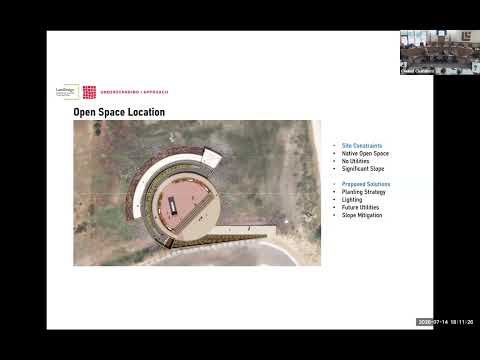
Julie Meneen Ek of Land Design and Lupe Cantu of Davis Partnership Architects described four concentric rings: an inner 'destruction' ring that uses red tones to evoke fire; a 'displacement and absence' ring with undulating, tumbled pavers to suggest confusion during evacuation; a 'snowfall and recognition' ring of white materials; and an outer 'redemption' ring of native plantings intended to educate visitors about Firewise landscaping. The designers said they relied on survivor testimony and historical imagery to shape material and symbolic choices. "We came up with an idea of the rings," Meneen Ek said, describing the structure and public‑gathering intent of the inner ring.
The team also proposed symbolic elements: a hearth or plinth with apertures that will align with the sun on the morning of the fire to highlight memorial details, and a field of steel posts intended in the Superior concept to represent lost structures — the designers noted 398 posts were proposed for Superior. They suggested low‑visual interpretive options, such as QR codes, rather than signage, and floated an optional pet memorial alternate that could connect visually to Louisville’s existing pet tribute.
Survivors and councilmembers endorsed the memorial's emotional and educational potential. Anne Brennan, a resident who said she lost her home, praised the design and urged the city to use the memorial to educate new residents about wildfire risk. Council member Judy Kern, speaking as a survivor, urged a unified remembrance that reflects everyone affected by the Marshall Fire, saying the event forged a regional community of survivors.
Council members raised practical questions. One council member asked whether the 'bumpy' tumbled pavers would be ADA accessible; the designers said the product can meet accessibility objectives. Council members also pressed whether Louisville losses would be acknowledged: designers said the Superior proposal reflected Superior's scope but that the concept could be adapted — for example by etching neighborhoods or by counting structures by neighborhood rather than only by town.
City manager Diana Langley explained the next step proposed by staff: a public survey run through the city’s Engage Louisville platform at no added cost. Langley clarified that the $35,000 the council previously set aside is specifically allocated "for a Marshall Fire 5‑year remembrance project" and cannot be redirected without further council action. "Those funds are allocated specifically for that," Langley said, framing the survey as a way to gauge public priorities about how to use already‑earmarked money.
Council did not make a final funding commitment at the meeting. Instead the council directed staff to run the survey and return with the results, and asked staff to coordinate further with Superior on design details and fundraising mechanics. The survey will report back to council, with staff advising on whether additional outreach or adjustments are needed before Louisville decides whether to contribute more funds or propose design changes.
The designers left the meeting open to feedback and questions and said they built flexibility into the concept to permit community‑driven inscriptions or adaptations. Councilmembers emphasized the memorial's dual goals: honoring lives lost while providing a public education moment about wildfire resilience. The council moved on to the next agenda item after thanking the presenters and members of the public who spoke.