Get Full Government Meeting Transcripts, Videos, & Alerts Forever!
Get email alerts on the Subdivision Regulations topic
No spam. Unsubscribe anytime.
St. Clair County commission reviews draft subdivision rules, debates 11,500-sq-ft average and 8,000-sq-ft minimum
Summary
Commissioners and residents questioned proposed lot-size thresholds, road and septic standards, and addressing requirements during a public work session; officials said the draft will be revised and posted for public comment before any adoption.
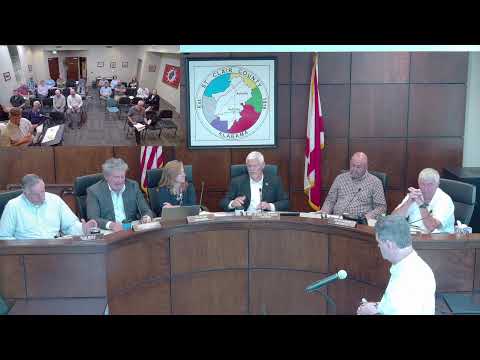
The chair of the St. Clair County Commission opened a public work session to review a draft of county subdivision regulations and said the meeting’s goal was to move toward binding standards while protecting residents from future infrastructure failures. "This is a called meeting of the county commission specifically to address, our move towards having some kind of subdivision regulations," the chair said.
Dan Dahlke, who led the presentation of the draft, outlined the plan for lot size and technical standards. "We came up with an average of 11,500 square feet, for each ... and lots would not be less. Any 1 lot cannot be less than 8,000 square foot," Dahlke said, explaining the document proposes an average lot size by phase with a lower-per-lot minimum.
Why it matters: Commissioners, municipal officials and residents said the lot-size choices affect school enrollment, police and fire capacity, road construction and eligibility for state or federal road funds. Several speakers said high-density subdivisions can create short-term spikes in service demand even if state education funding eventually follows students.
Arguments and concerns: A resident representing local schools pointed to past development that sharply increased enrollment, urging caution about short-term impacts: high-density projects, they said, can force costly reassignments and busing before new schools or staff are ready. Developers and other participants countered that overly restrictive minimums push growth to other counties and make projects financially infeasible; one developer noted traffic, sewer and water capacity are gating issues developers must secure before plat approval.
Technical tradeoffs: The draft addresses a range of technical standards beyond lot size. Commissioners discussed right-of-way widths (a typical 60-foot standard with 40 feet sometimes allowed by variance), the county engineer’s ability to require traffic studies and the role of ALDOT in permitting turn lanes. Commissioners and several presenters also debated private sewer systems versus individual septic tanks, the use of cash bonds to guarantee road completion, and who bears long-term maintenance liability.
9-1-1 addressing and emergency response: Ashlyn Campbell, the county’s 9-1-1 director, explained how addressing and road-naming feed emergency dispatch and utility service. "I assign the address, and then we disseminate that information to the utilities," Campbell said. Commissioners said the draft will require plats to include 9-1-1-compliant addressing before final engineering sign-off.
Legal and process limits: Commissioners discussed the legal boundary between zoning and subdivision regulation. Several members noted zoning typically governs density and that county-wide, across-the-board density limits can raise constitutional challenges unless tailored and supported by nexus findings. The commission said the draft is intended as an interim regulatory tool while broader planning conversations continue.
Public input and environmental concerns: Representatives of local environmental groups and long-term residents urged the commission to weigh runoff, wetlands and groundwater impacts from denser development. A representative of a river-protection group urged the panel to consider increased impervious surfaces and runoff when setting lot and street standards.
Next steps: The commission did not adopt the draft at the meeting. Commissioners said staff and county attorneys will revise the document, post it on the county website as a draft for public review, and schedule larger public forums before any vote. The chair said more commissioner-level discussion and at least one public meeting at a larger venue are planned to gather additional feedback.
No formal motion or vote occurred during the work session; the draft remains under revision pending additional public engagement and legal review.