Get Full Government Meeting Transcripts, Videos, & Alerts Forever!
Get email alerts on the Water Infrastructure topic
No spam. Unsubscribe anytime.
Council weighs painting rather than demolishing Lindsay Street water tower after bid opening draws no bidders
Summary
At a July 14 city council conference, utilities staff said no contractors responded to the project's bid opening and recommended a simplified two‑coat white paint to preserve the Lindsay Street water tower while staff pursues rebid and state‑contract options; demolition and reuse scenarios were discussed but no formal vote occurred.
On July 14, 2026, the city council continued discussion of the Lindsay Street water tower after staff reported that a scheduled bid opening produced no bidders.
The utilities director told the council that contractors said the original solicitation—eight different painting scenarios including partial and full options—had discouraged bidders. Staff recommended simplifying the scope to a single, two‑coat exterior white paint job to 'mothball' the tank and preserve potential future uses such as non‑potable irrigation. The director summarized the procurement problem: staff "had no one show up for bids" and, after talking with contractors, concluded a clearer, simpler solicitation was more likely to produce competitive pricing.
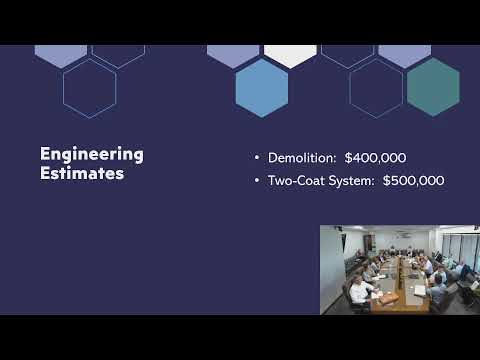
Why it matters: painting the tank would protect the asset and keep future options open for reuse or third‑party branding, while demolition would remove a possible future water source and carry higher immediate costs. Staff relayed a consultant estimate that demolition could be on the order of $400,000 (the consultant's informal estimate), while constructing a new tower previously ran roughly in the low millions; exact current numbers were not yet firm.
Councilors pressed staff on implementation details and tradeoffs. Councilor Grant said he was "for the two coat system," and asked whether lighting or projection should be included; staff recommended painting first and then separately bidding lighting or projection work to keep initial costs down. Council member Steve asked how long the two‑coat option would last; staff estimated about 10–15 years for the simpler exterior‑only approach versus up to about 20 years if the tank were fully blasted and rehabilitated at higher cost.
The council also explored reuse scenarios. Staff noted the tank could supply non‑potable irrigation (for the nearby golf course or parks) but that connecting users would require costly piping and easements that do not currently "pencil out" without grants or larger customer commitments. Councilors discussed developing a discounted non‑potable water rate and seeking grants to subsidize pipe installation if a reuse partner emerged.
Procurement next steps: staff recommended keeping the consultant item on the agenda for continued work, removing a related agenda item until a viable bid is available, and pursuing alternate procurement paths (including a state bidding contract) to avoid or shorten a 21‑day rebid cycle. Staff said they would rebid with a simplified scope and report back with updated pricing and options.
No formal council motion or recorded vote occurred during the discussion. The presiding official indicated the requested items would be pulled as staff recommended and that staff should return with pricing and a recommendation. The council did not commit to demolition and several members signaled support for the lower‑cost painting approach to preserve future options.