Get Full Government Meeting Transcripts, Videos, & Alerts Forever!
Get email alerts on the Transportation E Bikes topic
No spam. Unsubscribe anytime.
Committee amends e-bike rules to match expected state law, adds safety and equipment limits
Summary
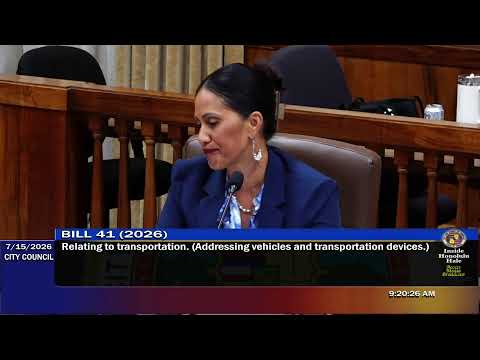
The Honolulu City Council Committee on Infrastructure, Transportation and Technology amended Bill 41 (CD1) July 15 to align city regulations with an expected state e-bike law, add a 10 mph sidewalk speed limit, prohibit unauthorized modifications that increase speed or power, and create battery-compliance requirements.
The Honolulu City Council Committee on Infrastructure, Transportation and Technology amended Bill 41 (CD1) on July 15 to align city code with an expected state law governing electric bicycles and other micro-mobility devices, and to add new safety and equipment provisions.
Councilmember dos Santos Tam, who introduced the CD1, said the revisions incorporate recommendations from the Hawaii Bicycling League and the Department of Transportation Services and are intended to reduce enforcement gaps between state and county rules. “With this bill, we’re trying to align them so it’s much easier for an HPD officer to say this is both against state law and county law and there’s no wiggle room in between,” he said.
The hand-carried CD1 read into the record makes multiple changes to Honolulu’s Revised Ordinances: it adds or clarifies definitions (including a definition for a motor-driven cycle), renumbers sections for drafting consistency, restores some existing language and deletes other proposed language, and inserts substantive safety provisions. Key items added or clarified include a provision allowing riding a bicycle — including class 1, 2 or 3 electric bicycles — on sidewalks provided the speed does not exceed 10 miles per hour, riders yield to pedestrians and give an audible signal before overtaking; a proposed prohibition on unauthorized upgrades or alterations that would allow a device to exceed speed or power maximums established in state law; and a new section establishing electric system and battery compliance standards for e-bikes, electric foot scooters and other micro-mobility devices.
Eduardo Hernandez of the Hawaii Bicycling League testified in support of the amendments, saying the league represents more than 1,000 members and supports measures that make bicycling safer. Hernandez also highlighted outreach efforts and announced two helmet distribution events (Sheridan Park and a retail outlet later this month) and offered the league’s e-bike fleet for council members and staff to try.
Tony Valdez of the Department of Transportation Services raised technical and implementation questions, urging the bill use the word “modified” rather than “upgraded,” asking which authority would make reclassification decisions, and expressing concern about the city’s ability to regulate commerce — for example, online sales of equipment used to modify vehicles. Valdez asked for Corporation Counsel input on those points.
Councilmember Tupala noted the state’s point-of-sale and labeling timeline includes a 120-day implementation period and urged the committee to consider signage and disclosure responsibilities for manufacturers and distributors. In response to DOT concerns about commerce regulation, Councilmember dos Santos Tam cited city precedents for restricting sales of certain goods and said he was confident the approach would withstand legal challenge.
The chair offered a verbal amendment on the record, replacing “upgrade” with “modified” in the hand-carried CD1. With no objections or reservations voiced, the committee amended Bill 41 to CD1 as verbally amended and recommended it be reported out for passage on third reading.
Next steps: The committee reported the amended Bill 41 (CD1, as amended) out for passage on third reading; the transcript records the committee’s recommendation and that there were no objections, but no roll-call vote tally was recorded at the meeting.