Get Full Government Meeting Transcripts, Videos, & Alerts Forever!
Get email alerts on the Wastewater Testing topic
No spam. Unsubscribe anytime.
Board discusses nitrogen thresholds, testing compliance and education for innovative alternative septic systems
Summary
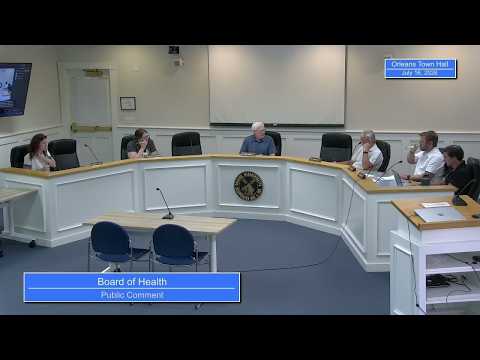
The Orleans Board of Health debated standards for approving reductions and monitoring innovative alternative (IA) septic systems, focusing on a 19 ppm nitrogen threshold, sampling frequency, data reporting, and a staged approach (education, show-cause, enforcement). Staff will draft a form letter and educational flyer for owners.
Staff presented a discussion framework for reviewing reduction requests and approvals for innovative alternative (IA) septic systems, centering on whether applicants meet the nitrogen standard (19 parts per million) and required sampling frequency (typically quarterly).
Meredith told the board operators often fail to submit required data and that testing frequency and data completeness vary. "They're not testing at all," one board member observed, and others described widely differing nitrate and total nitrogen results in recent reports. Board members pressed for clearer standards — for example, whether approvals should be denied if tests exceed 19 ppm on an individual sample or on an average — and proposed objective triggers for follow-up such as "three of four tests above 19 ppm" or repeated exceedances across testing cycles.
Members proposed a staged compliance approach: an educational outreach (a one-page flyer and a form letter tailored to each property's required conditions), followed by staged testing sequences and, if necessary, show-cause hearings or fines. Meredith said a draft of the form letter should be ready by August and that staff will begin assembling an educational pamphlet; she also suggested coordinating with Barnstable County to improve the county database so it can flag noncompliant operators.
Board members flagged practical issues: testing costs for homeowners, incomplete reporting from testing firms, and the need to deny reduction-in-testing applications from properties that have not demonstrated compliance for a required period. The board asked staff to return with a draft letter and proposed numeric thresholds and enforcement steps at the next meeting.
Next steps: staff to draft the letter and a one-page flyer by August, coordinate with the county on data reporting, and present proposed numeric criteria and staged enforcement steps for board review.