Get Full Government Meeting Transcripts, Videos, & Alerts Forever!
Get email alerts on the Budget topic
No spam. Unsubscribe anytime.
Hardin County commissioners discuss FY2027 budget, back emergency‑management deputy and hazardous‑duty pay increase
Summary
In a July budget workshop the Hardin County Commissioners reviewed department requests for the proposed FY2027 budget, including a pay bump for a county court coordinator, a part‑time assistant for veteran services, creation of an emergency‑management deputy, and a countywide hazardous‑duty pay proposal; the court signaled support for the middle hazardous‑duty option and agreed to move forward on staffing requests pending final budget calculations.
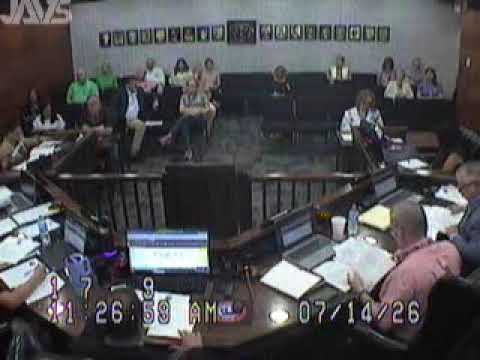
The Hardin County Commissioners Court met in a budget workshop to review requests for the proposed fiscal year 2027 budget, with the County Judge opening the session and walking the court through revenue, expenditures and department requests. The judge framed the workshop as the chance to set a proposed budget that will later be presented for final approval by the court.
The judge presented several items from his office, including a request to raise the county court coordinator’s pay to parity with district court coordinators. He said the change reflects similar duties and noted the increase would be partly offset by savings elsewhere and by higher bond costs that already appear in the draft budget. The judge asked commissioners for input before deciding whether to include the adjustment in the proposed budget.
Veteran Services Officer Kristen White asked the court to add an assistant VCSO (at least 1,000 hours per year) so the office can maintain casework and pursue grant opportunities. White told the court the assistant would require Department of Veterans Affairs credentials and would allow her to handle more outreach and grant work such as ramps and financial assistance while ensuring case continuity. Several commissioners voiced support; one commissioner opposed expanding an already part‑time position, but the judge and others recommended exploring a temporary/part‑time option and modeling the expense before the October 1 budget start date.
Emergency Management Coordinator Aaron Tucker requested creation of a deputy or assistant emergency management coordinator to handle expanded responsibilities—preparedness, training, public information, grant management and around‑the‑clock response. Tucker and the judge presented regional salary comparisons (Jefferson County and Orange County examples) and suggested a mid‑$20s hourly rate (roughly $55,000 annually plus fringes) as a starting point. Commissioners expressed support for adding capacity and for succession/redundancy planning in the emergency‑management office.
Representatives for the county’s Justices of the Peace submitted a memo asking either higher vehicle allowances (discussion centered on increasing the current $7,200 allowance by about $4,200 per office) or a comparable salary increase. Commissioners discussed whether to pay the increase as an auto allowance (which has different benefits implications) or move the dollars into salary lines that count toward retirement. The court asked staff to model both options and potential fringe impacts.
County Attorney Smith (as identified in the record) described several more limited adjustments in his office: adding funds for software renewals after an expected savings did not materialize, retaining existing cell‑phone funding, and increasing dues to cover assistant attorneys’ bar dues. Smith also proposed using the county’s pretrial diversion (SB22) funds to provide modest stipend increases for grant‑funded staff who are not eligible for the countywide COLA. The DA (Miss Walton) said her office had modest equipment and dues adjustments and also intended to use pretrial diversion money to afford a small staff increase.
On compensation policy, the judge revisited a proposed hazardous‑duty pay for law enforcement. He presented three options—$150, $175 (his recommendation), or $200 per pay period—and recommended including the sheriff and constables. Commissioners discussed budget impacts and fringe costs and several members indicated support for the middle option ($175 per pay period) and inclusion of the sheriff and constables in that pay type; staff was directed to model the total cost and fringe effects.
The court discussed health insurance premiums and a rise in dependent‑coverage costs. County staff and the sheriff urged that, if possible, the court prioritize mitigating the dependent‑coverage increase to preserve the county’s prior gains in employee enrollment. Commissioners asked staff to run numbers and identify whether the general fund balance or contingency could be used to dampen the increase.
The County Judge proposed baseline salaries for appointed department heads—approximately $65,000 for 0–5 years in role and $70,000 for 5+ years—with longevity and step pay to follow; commissioners asked for details and modeling.
Several items drew consensus or direction: multiple commissioners signaled support for the veteran‑services assistant request and for creating an emergency‑management deputy; the court expressed support for the middle hazardous‑duty pay option pending final cost modeling; and the judge said staff would return to the court with updated spreadsheets and revised projections before finalizing the proposed budget. Commissioner Kuykendahl moved to adjourn; Commissioner Cooper seconded and the court adjourned.
Next steps: staff will refine the spreadsheet to incorporate the items discussed, model the insurance premium scenarios and the hazardous‑duty/fringe impacts, and return to the court with updated numbers prior to the formal budget adoption process.