Get Full Government Meeting Transcripts, Videos, & Alerts Forever!
Get email alerts on the Wetlands Rulemaking topic
No spam. Unsubscribe anytime.
Environmental Management Commission hears broad opposition to rule tying North Carolina wetlands to federal definition
Summary
At a June 26, 2025 public hearing, residents, environmental groups and scientists urged the Environmental Management Commission not to adopt a rule that would limit state wetland protections to those classified under a narrower federal "waters of the United States" definition required by session law 2023-63. Speakers warned of increased flooding, loss of habitat and harms to fisheries.
Raleigh, N.C. — The Environmental Management Commission on June 26 held a public hearing on proposed amendments to the state wetlands definition (15A NCAC 02B .0202) required by session law 2023-63, and dozens of speakers urged the commission and the Department of Environmental Quality to avoid tying North Carolina's protections solely to a narrower federal standard.
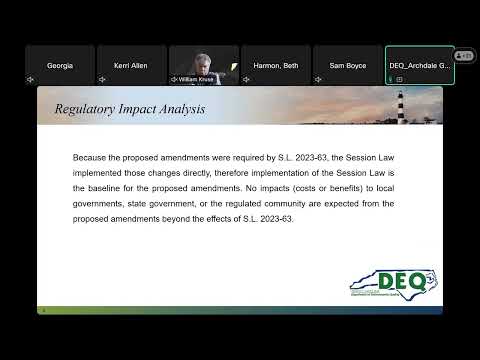
Sue Homewood of the Division of Water Resources described the rule and timeline: the rule implements the session law, the public comment period remains open through June 30, 2025, and the hearing officer's report is expected to go before the EMC on Sept. 11, 2025, before further administrative review and EPA consideration.
Why it matters: Speakers representing conservation groups, coastal communities, scientists and residents said the change would shift decision-making about which wetlands merit protection to a federal definition that recent court rulings and federal guidance have narrowed. They warned that losing protections for non-tidal and isolated wetlands would reduce flood storage, degrade water quality, and harm fisheries and local economies.
Claims and concerns from the hearing: Dr. Adam Gold, a senior manager with the Climate Resilient Coast and Watersheds team at the Environmental Defense Fund, said recent court decisions and federal actions have already narrowed Clean Water Act protections and that "tying North Carolina wetlands protections to the federal definition will supercharge loss of wetlands and their benefits that all North Carolinians rely on." He presented EDF modeling that, depending on interpretation, could leave hundreds of thousands to millions of acres without federal protections; he characterized those figures as estimates and urged caution.
Multiple conservation groups reiterated local and economic risks. "This change would significantly weaken protections for wetlands that reduce flooding, filter pollutants and support fisheries," said Lisa Bridal, executive director of Coastal Carolina River Watch. Chris Herndon, director of the North Carolina chapter of the Sierra Club, highlighted three concerns'financial costs of increased flooding, the accelerated loss of unique wetland types (Carolina Bays, pocosins, cypress savannas), and the loss of state authority over which wetlands to protect.
Legal and process notes: Several speakers, including attorneys from the Southern Environmental Law Center, criticized the statute-driven text as limiting the EMC's discretion to craft science-based rules. "When rulemaking works as intended, the experts on the subject matter of the rule are involved in crafting the rule," said Brooks Rainey, a senior attorney at SELC, and he urged the commission to use its influence with the General Assembly to restore expert-led rulemaking.
Local examples and science: Speakers described community restoration work and local flooding tied to development on wetlands. Testimony emphasized the ecosystem services of wetlands: floodwater storage, water filtration, carbon sequestration and nursery habitat for commercial and recreational fisheries. Several speakers explicitly urged that the commission delay formal adoption and work with the legislature to preserve broader state protections where possible.
What the rule does not change now: DEQ staff and the hearing officer repeatedly noted that the session law requires the commission to adopt rule text consistent with the statute; the hearing is a forum to gather public comment that the hearing officer will review and summarize for the EMC. No vote or formal decision was taken at the hearing.
Next steps: Written comments will be accepted through June 30, 2025. The hearing officer will prepare a recommendation for the EMC, which is expected to consider the record at its Sept. 11, 2025 meeting. Any final rule will undergo administrative review and, as applicable, EPA review.
The hearing closed after public comment and procedural reminders from hearing officer Tim Baumgartner.