Get Full Government Meeting Transcripts, Videos, & Alerts Forever!
Get email alerts on the School Funding topic
No spam. Unsubscribe anytime.
Bonneville district cites roughly $7M attendance-driven shortfall, asks voters to approve $3.8M levy increase
Summary
A district official told a public meeting the BONNEVILLE JOINT DISTRICT faces about a $7 million operating gap after a state shift to attendance-based funding and declining enrollment, and outlined a May ballot request for a $3.8 million levy increase alongside about $4 million in planned cuts if voters reject the ask.
A district official said the BONNEVILLE JOINT DISTRICT faces an operating shortfall of about $7 million after the state moved to attendance-based funding and student enrollment declined, and asked voters in May to approve a $3.8 million increase to the district’s supplemental levy to help close the gap.
The official described the district’s budget in recent years as roughly $100 million to $120 million and said the board aims to keep about 5% in reserve, roughly $5 million to $6 million. “That $7,000,000 gap is really the gap that we’re that we’re struggling to fill,” the official said, tying the shortfall to a shift from enrollment-based to attendance-based funding and to an average daily attendance rate of about 93 percent.
Why it matters: State funding based on attendance pays the district for students who show up on a typical day rather than every enrolled student. The speaker said that difference — about 7% of enrolled students — converts to an annual revenue shortfall the district must cover through reserves, spending reductions, or additional local levies.
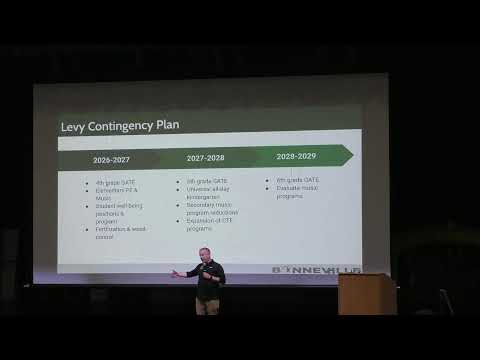
What the district is asking and what would be cut: The district currently operates a supplemental levy of $5.8 million that voters renewed last November. Officials are proposing an additional $3.8 million in May and planning roughly $4.0 million in cuts if the increase fails. Leaders said the $3.8 million would preserve programs they flagged as priorities: universal all-day kindergarten, elementary music and physical education, student well-being and life-skills positions, gifted-and-talented services, and career-technical education.
“If we don’t have that increase, we also don't have the state funding to support those,” the official said, adding the district would need to eliminate or reduce programs in a staged way to minimize disruption. As an example, officials said elementary PE and music would stop next year if the levy increase fails, affecting an estimated 28 classified paraprofessionals; the district would consider other phased changes to all-day kindergarten in the following year.
Budget drivers and one-time funds: The official said federal COVID-relief dollars temporarily boosted the district’s fund balance in 2021–2024, allowing one-time spending and higher reserves. But those federal dollars were time-limited, and the district has since seen its reserves decline as temporary funds were spent and recurring costs grew.
State policy and legislation: The speaker said a 2023 legislative bill that would have returned funding to enrollment-based calculations passed the legislature but was vetoed by the governor, halting that reform. The official told attendees the legislature has not reintroduced such a bill and, given the current state fiscal outlook and the governor’s stated position, he did not expect a short-term change.
Program- and line-item details discussed in questions: Officials identified specific potential reductions and budget levers — for example, cutting the Lexia literacy software contract (about $175,000), reverting from 1:1 Chromebooks in elementary schools to shared lab models, and reassigning some district-funded certified positions back to school allocations. They also clarified that secondary sports are funded within the current supplemental levy language and would not be part of the additional $3.8 million ask.
Special education and federal limits: The official said special education remains under review but cited a federal rule that constrains how much the district can reduce special-education spending year over year — “we can’t spend less next year or, sorry, less next year than we spent this year,” he said — requiring careful planning for any staffing or hours changes in that area.
Other options considered: Attendees asked about a four-day school week; the official said the district studied peer districts and found mixed results on attendance gains and only modest financial savings (child nutrition, utilities), not enough to close the multi-million-dollar gap by itself.
Next steps: Officials said the current $5.8 million levy remains in place through next year even if voters reject the May increase; if the May increase fails the district would likely present options to voters again in November, with the board deciding the exact ask. Staff said they will continue outreach — weekly parent and employee updates and social-media messaging — and expect personnel-notification decisions to proceed in the coming weeks as principals assess school-level staffing.
The district official closed the session by inviting continued feedback and directing attendees to email questions as the board prepares decisions in May.