Get Full Government Meeting Transcripts, Videos, & Alerts Forever!
Get email alerts on the Behavioral Health Systems topic
No spam. Unsubscribe anytime.
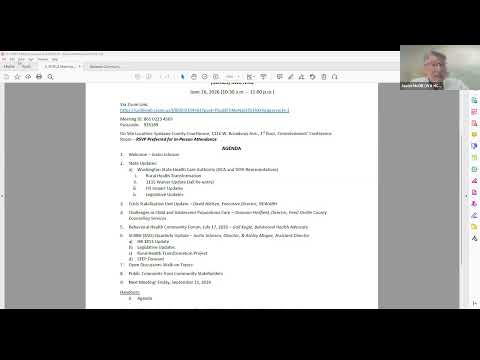
Spokane region discusses youth service gaps, HB1813 implementation and a 25‑person pre‑filing diversion pilot
Summary
County and regional partners discussed limited inpatient and youth placements, coordination challenges across DCYF/hospitals, HB1813 delegation work, and a Step 4 pre‑filing diversion pilot with about 25 active participants connecting people to treatment instead of felony charges.
Shannon Haulfield, introduced as director of Pendrick County Counseling, raised persistent gaps in services for severely emotionally disturbed youth and complex adults in rural counties, describing a specific case of a child under 13 with repeated out‑of‑area placements and hospital stays. Haulfield urged better coordination across counties and state agencies and asked the group for examples of solutions that work at small scale.
Peers recommended greater use of telehealth, stronger regional partnerships with hospitals, and clearer state‑level roles and communications. Justin Johnson and other regional leaders emphasized that some issues require state action, more resources, and better coordination between custodial placements and behavioral health services.
Regional updates: Ashley McGee briefed the group on Spokane Regional BHSO priorities, including HB1813 implementation (delegating certain crisis stabilization management back into regional flows) and a rural health transformation initiative focused on mobile crisis expansion. McGee also reported on Step 4, a voluntary pre‑filing diversion program operated with the Spokane County Prosecuting Attorney's Office; the most recent update noted about 25 active participants engaged in diversion instead of felony filings.
Why it matters: Rural counties face particular challenges getting intermediate levels of care for youth and high‑need individuals; coordination gaps between DCYF, hospitals, and local providers can produce repeated out‑of‑area placements and longer ER stays. The Step 4 pilot represents a local effort to divert people to treatment and reduce felony filings when behavioral health needs are primary.
What comes next: The region will continue forums and roundtables (including a July community behavioral health forum) to gather needs and roll recommendations into regional/state planning, and will track Step 4 outcomes for future data reporting.