Get Full Government Meeting Transcripts, Videos, & Alerts Forever!
Get email alerts on the Growth Monitoring topic
No spam. Unsubscribe anytime.
Steering committee backs annual regional monitoring, asks PTAC for technical plan
Summary
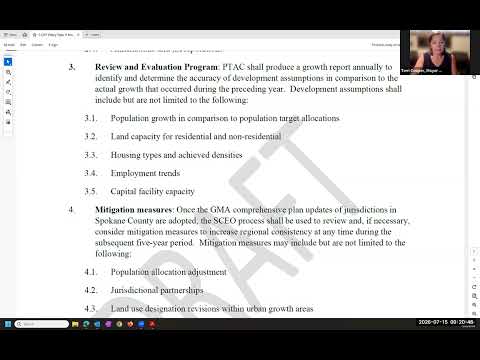
Steering committee members agreed in principle to annual monitoring of housing and land-capacity indicators and discussed designating Spokane County as a central data repository; staff will send revised policy text to the Planning Technical Advisory Committee (PTAC) for technical recommendations before the steering committee’s Aug. 12 meeting.
The Growth Management Steering Committee of Elected Officials moved to advance a countywide monitoring-and-reporting policy on July 15, agreeing in principle to annual data collection while asking PTAC for technical guidance on what is feasible.
Staff opened the workshop presenting clean and redline drafts of the monitoring-and-reporting policy and asked members to treat the session as a committee-of-the-whole to resolve objections before returning a revised draft to PTAC. PTAC’s representative, Steve, asked that PTAC be given the committee’s proposed changes so PTAC can provide follow-up technical recommendations.
City of Spokane planning staff raised concerns that parts of the draft duplicate state Commerce guidance and that referencing figures from the Spokane County comprehensive plan before those figures are adopted would create a circular requirement. The staffer urged editorial cleanup and recommended PTAC review to refine which data items are necessary.
Several members proposed that Spokane County serve as a regional repository for submitted city and town data to improve consistency. “Having the county take on that task and provide and do the reporting and be sort of a regional repository for that would probably ensure that these reports are consistent,” a city staff member said.
Committee members debated annual reporting versus less frequent cycles. Supporters said annual reporting creates a dataset to spot trends and informs future allocation decisions, while others cautioned that a single year of data may not justify policy changes. One member summarized the tradeoff: collect annual data to build a multi-year sequence, but require three or more years of variance before changing allocations.
No formal policy adoption occurred at the workshop. Staff stated PTAC will meet in early August and return technical recommendations to the steering committee for consideration at its Aug. 12 meeting.
Next steps: staff will incorporate today's comments, send the revised draft to PTAC for technical review, and present PTAC's recommendations to the steering committee on Aug. 12.