Get Full Government Meeting Transcripts, Videos, & Alerts Forever!
Get email alerts on the Traffic Safety topic
No spam. Unsubscribe anytime.
Forest Heights forum on stop‑sign camera enforcement highlights safety gains and resident concerns over fairness and transparency
Summary
Forest Heights held a July 15 forum where police and vendor Avio presented data showing declines in stop‑sign violations after camera deployment while residents pressed for clearer markings, contract transparency, relief for multiple tickets and engineering fixes. Town officials said revenue ($433,426) must go to public‑safety improvements and pledged to continue the review.
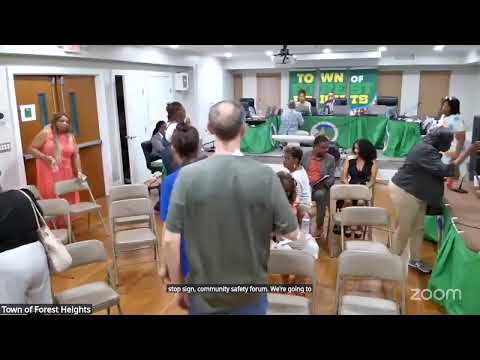
Forest Heights held a community forum on July 15, 2026, to review its stop‑sign camera enforcement program after residents raised questions about calibration, visibility of stop lines, appeals and how fines are used. The forum featured Police Chief Daniel Ruffin and vendor Avio representatives Ricky Seaman and Wade Borman, along with dozens of residents attending in person and online.
Avio’s community lead, Ricky Seaman, said the program has driven a substantial reduction in flagged violations at Forest Heights camera sites and that the majority of citations go to nonresidents. “98% of the citations that are issued in Forest Heights are not Forest Heights residents,” Seaman said, adding that resident citations account for roughly 2.2% of the total and that the company’s review process checks every flagged video before a ticket is mailed. Seaman also presented site‑level declines — several locations showed reductions of 50% or more since enforcement began.
Chief Daniel Ruffin described the enforcement threshold to residents: a correct stop, he said, is when a vehicle comes to a complete stop before the white stop line. He and Avio staff said the camera system flags events in which a vehicle’s wheels enter the stop‑line box while still moving, and that staff review footage before issuing a citation. “Every single person has the right to go before the judge and appeal every single citation that they are given,” Ruffin said, noting the town’s ombudsman can also review disputable cases before referral to court.
Multiple residents said faded pavement markings, trimmed vegetation and sight‑line obstructions have caused drivers to be cited even when they believed they had stopped safely. Jonas Mitchell, a neighborhood resident, described intersections where parked vans and trees make it difficult to see approaching traffic and suggested adding a “stop here” sign to mark the required stopping point. “There should be an extra—sorry—there should be an extra sign that says stop here at the line,” Mitchell said.
Other commenters stressed economic and privacy concerns. Tracy Mow, a member of the town’s beautification committee, called the high number of violations an engineering problem rather than primarily a driver problem and called flat fines regressive: “A flat fine is regressive by design. Forty dollars is nothing to some households and a missed bill to others cascading into late fees, court costs, lost licenses…That’s not safety. That’s tax for being poor,” she said, urging that the Avio contract be published and asking how long footage is retained and who can access it.
Residents also asked about revenue and vendor profits. When asked how much the program had produced for the town, Avio provided a town‑revenue figure of $433,426 and stated that, under the enabling legislation, funds must be used for public‑safety pedestrian improvements such as sidewalks, crosswalks, striping or lighting. Avio staff reported vendor receipts of about $404,054 to date and said the company maintains hardware and software and sends technicians for calibration and maintenance. Town staff said they do not budget to rely on citation revenue and presented using funds for capital safety improvements as an intended option.
Several speakers pressed for operational clarifications and remedies: how many warning letters were mailed (Avio said 1,910 during a 30‑day warning period), how the repeat‑offender policy works (Avio clarified a 10‑day then a shorter 3‑day spacing policy across the Forest Heights system), how to contact support (Avio provided support@letsdrivesafer.com and (855) 655‑6621), and how residents can contest stacks of citations (ombudsman review and court). Avio also said it waives certain repeat citations so penalties do not simply accumulate in short succession.
Residents proposed engineering alternatives—adding stop lights at complex intersections, repainting faded lines, trimming sight‑line obstructions and adding explicit pavement signage to mark where vehicles must stop. Avio said it would replace missing signage where needed and deferred traffic‑engineering questions to traffic engineers and the county, which oversees the pilot program and will review annual data to determine whether it is meeting safety goals.
The mayor’s moderator closed the forum by identifying three questions for ongoing work: whether the town’s enforcement policy aligns with public‑safety goals, what policy adjustments would improve public confidence while maintaining safety, and what success benchmarks should guide any pause, modification or conclusion of the program. The town said the conversation will continue and that staff will collect written feedback, publish additional program details where possible and follow up on specific resident concerns.