Get Full Government Meeting Transcripts, Videos, & Alerts Forever!
Get email alerts on the Transportation topic
No spam. Unsubscribe anytime.
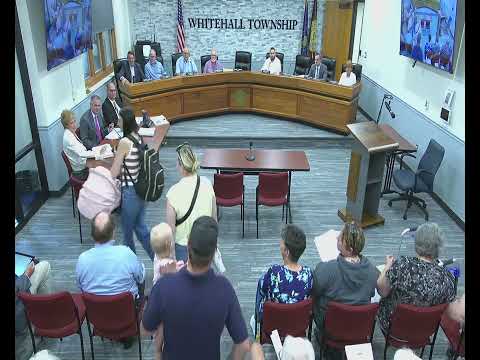
Whitehall commissioners back plan to pilot one-way, parking and speed-hump changes on Water Street
Summary
After extensive public comment and technical review, commissioners directed staff to pursue a temporary one-way pilot on Water Street with marked pedestrian space, parking on one side and up to three temporary speed humps while engineers refine drainage, lighting and cost estimates. Final implementation requires the mayors approval.
A majority of the Whitehall Township Board of Commissioners signaled support for a temporary one-way pilot on Water Street after a lengthy public discussion of traffic, parking and safety trade-offs.
Commissioner Ken Snyder presented the plan developed in a workshop: convert the closed portion of Water Street to a one-way, provide a 12-foot travel lane, mark an 8-foot parallel parking strip on one side (yielding roughly 11 on-street spaces in one layout), and paint a 3- to 4-foot pedestrian area where sidewalks are missing. "That would give us that arrangement to start out with," Snyder said, outlining how the configuration would preserve pedestrian access while allowing on-street parking for residents.
Traffic engineering staff and consultants emphasized the measures are temporary and need refinement. The townships traffic engineer explained that a one-way lane at 12 feet would make room for a visible pedestrian zone and parking, but warned engineers must avoid creating concentrated drainage that could flood private property. "Placing a speed hump at the wrong place could have water going to his door," the consultant said, pointing to low spots near a house with a yellow door on the plan.
Residents who live on or near Water Street gave mixed feedback. Some called for concrete barriers at event sites and attention to a missing guardrail at Main and Pine; others said a one-way could increase speeds without additional calming. "If you make it one way, people could go faster because it's a 12-foot lane," a resident warned; commissioners replied that proper signage, marked walkways and temporary speed humps would be used to control speeds.
Engineering staff recommended three temporary speed humps placed along the length of the pilot and said a detailed topographic survey is required before permanent work. The board instructed staff to: meet with Public Works, calculate temporary vs. permanent costs (including lighting and signage), and return with a proposed schedule. The board noted the mayor has the authority to close or reopen the street temporarily and any pilot will be coordinated with the mayors office.
Commissioner discussion also raised operational questions for large vehicles and trash pickup: staff said smaller trucks or backing maneuvers are typical in constrained streets and that temporary changes should consider delivery and waste-collection operations.
The board did not authorize construction tonight. Instead, commissioners agreed on pursuing a temporary one-way pilot and asked staff and consultants to provide cost estimates, a timeline for installation of markings and temporary humps, and recommendations for data collection (speed and volume) to evaluate the pilot. The plan will return to the board and requires the mayors approval for temporary reopening.
Next steps: staff will finalize topographic data and cost estimates and propose a short-term schedule for installation and evaluation; the board will reconvene on a timeline and consider a comparative traffic study before any permanent changes are approved.