Get Full Government Meeting Transcripts, Videos, & Alerts Forever!
Get email alerts on the Commercial Affordability Small Businesses topic
No spam. Unsubscribe anytime.
OED briefs council on commercial affordability; small businesses and consultants urge more lease transparency and permitting help
Summary
Office of Economic Development staff outlined programs to anchor neighborhood businesses — including prelease support, tenant-improvement grants and a business community ownership fund — while small-business owners and consultants described rising rents, expanding triple-net costs and complex permitting that hinder lease success.
The Seattle Office of Economic Development (OED) told the Human Services, Labor and Economic Development Committee it is using a mix of programs and pilots to address commercial affordability for neighborhood small businesses, while a roundtable of consultants and business owners described barriers that can keep microenterprises from securing and staying in leased storefronts.
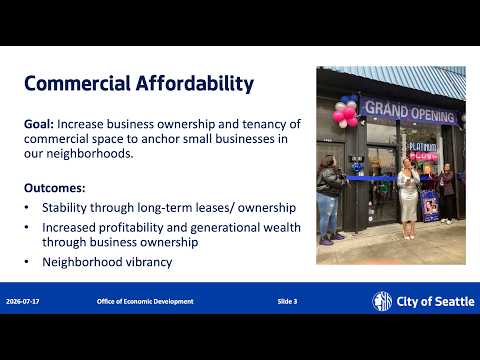
Alicia Teal, deputy director of OED, said the office's work is guided by the city's "Future of Seattle Economy" framework (Resolution 32099) and focuses on small-business stability, community wealth building and neighborhood commercial ownership. Heidi Hall and Jen Cheroni of OED outlined programs including Seattle Restored storefront pilots, a prelease program to prepare pop-ups for long-term leases, tenant-improvement grants, capital access partnerships with community development financial institutions and the Business Community Ownership Fund (BCOF) pilot that acquires commercial spaces to anchor businesses.
"Commercial affordability ... really focuses on small businesses or brick-and-mortar businesses in neighborhoods," Teal said. OED described the prelease program as a way to help entrepreneurs become lease-ready with planning, permitting assistance and capital preparation.
Consultants and owners at the roundtable emphasized recurring, concrete obstacles. Shanti Bresna, a commercial-space consultant who works with OED programs, said rents have continued to rise and that triple-net pass-through costs (insurance, property taxes and common-area maintenance) have grown sharply since the pandemic, particularly when vacancy increases shift more building costs to fewer tenants. She illustrated typical tenant-improvement costs by describing a prospective bakery whose initial build-out estimate approached $500,000 but was reduced to about $200,000 through project scoping and consulting.
"One thing I would really wish people knew when they sign leases is: what is the space currently certified for? What is the certified occupancy for the space?" Bresna said, stressing that undisclosed changes of use can create major permitting and cost surprises.
Panelists also urged better front-end information for prospective tenants: a clear indication of permitted uses for a space, accessible guidance on likely triple-net exposure, and a simplified permitting map. Councilmember Juarez praised the panel and asked OED and partners to consider producing a flowchart or step-by-step guide showing the common permit and review steps small businesses face.
Several small business owners described how OED's tenant-improvement assistance helped them secure space but said longer-term wraparound support after project completion was limited. Nikkita Mathis, owner of Platinum Plus Fashions in Southeast Seattle, said the tenant-improvement grant and consultant guidance were invaluable but that post-project supports were not sustained.
OED staff said they are working on commercial tenant-transparency legislation and continue partnering with SDCI on permitting improvements; they flagged recent work on "substantial alterations" exemptions that reduced some permitting burdens for small commercial spaces. Committee Chair Alexis Mercedes said the roundtable represented the start of a larger body of work and that staff and panelists will follow up with additional meetings and potential committee action.
Next steps: OED indicated it expects to submit commercial-transparency legislation soon and will continue stakeholder engagement; councilmembers asked staff to return with concrete tools (for example, a permitting flowchart and clearer permitted-use information) to help small businesses evaluate and secure leases.