Get Full Government Meeting Transcripts, Videos, & Alerts Forever!
Get email alerts on the Data Collection topic
No spam. Unsubscribe anytime.
DHHS clarifies CIE definitions and data tool ahead of Inclusion Works incentive rollout
Summary
DHHS staff explained revisions to the data tool that will distinguish CIE vs non‑CIE employment, outlined five CIE criteria, and described a two‑step assessment and career development plan that will guide eligibility and supports for providers and tailored plans.
On the Inclusion Works webinar, DHHS staff spent substantial time clarifying how providers should complete the quarterly CIE data tool and why the agency will reword a confusing ADVP question to ask explicitly whether an individual is employed in a non‑CIE setting.
Austin Glass, who leads project management and reporting for Inclusion Works, reviewed the five criteria that constitute competitive integrated employment: (1) compensation at or above minimum wage; (2) comparable wages to employees without disabilities doing similar work; (3) comparable benefits; (4) worksite integration where employees with disabilities interact with people without disabilities; and (5) opportunities for advancement. Glass said an individual must meet all five criteria to be classified as employed in CIE.
Glass walked through examples providers should use when completing the tool: community jobs like fast‑food employment count as CIE if criteria are met; provider‑site work that lacks integration or 14(c) subcontracted work should be recorded as non‑CIE; and someone working multiple jobs could legitimately be marked both CIE and non‑CIE depending on the positions. He said the tool will be distributed in an updated form in December and will continue to be sent quarterly.
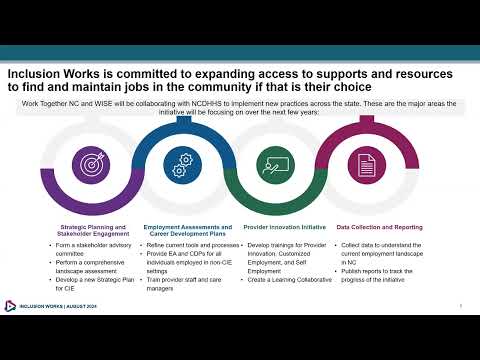
Mike Chapman of Work Together NC described the assessment process that underpins the career development plans: a preliminary employment assessment to capture an individual’s interest, history and informed choice followed by a plan that includes exposure opportunities, required supports, and accountability for staff assignments. Chapman said vocational rehabilitation (EIPD/VR) will be a partner and may conduct additional, distinct vocational assessments tied to those plans.
DHHS cautioned that the numeric counts presented during the webinar are preliminary and asterisked while staff continue outreach to providers to clean up the data. Glass summarized the snapshot (May 31): 1,744 individuals tracked; 1,457 active in ADVP/ILOS/LTCS; 534 employed in non‑CIE settings; and 923 receiving only day services. The agency will issue allocation letters to tailored plans and send lists of eligible members so providers can begin outreach and documentation collection.
DHHS said it will publish a glossary of acronyms and an FAQ on the Inclusion Works website, and will provide training through monthly stakeholder meetings and periodic lunch‑and‑learns to help providers correctly implement data collection and the new incentive program.