Get Full Government Meeting Transcripts, Videos, & Alerts Forever!
Get email alerts on the Incentive Program topic
No spam. Unsubscribe anytime.
DHHS launches Inclusion Works incentive: providers to receive $2,500 at hire and $2,500 after 180 days for eligible CIE starts
Summary
The North Carolina DHHS announced an Inclusion Works incentive that pays providers $2,500 when an eligible member begins verified competitive integrated employment (CIE) and $2,500 after 180 days, targeting people working only in non‑CIE settings; payments run July 1, 2024–June 30, 2025.
The North Carolina Department of Health and Human Services (DHHS) on a statewide Inclusion Works webinar described a new incentive program that will pay providers $2,500 when an eligible member begins verified competitive integrated employment (CIE) and a second $2,500 after the person remains in CIE for 180 days, for a total of $5,000 per person.
Claire Culligan, the IDD employment lead for DHHS’s Division of Mental Health, Developmental Disabilities, and Substance Use Services, said providers who are actively working with an individual to locate and maintain a CIE job will receive the payment. “When a person does start CIE and the employment start date is submitted to the tailored plans, when the tailored plans and the state have verified that the CIE is happening…providers will receive the first payment, and that is the $2,500 payment,” Culligan said.
The incentive applies regardless of hours worked, Culligan added. There is no requirement that participants stop non‑CIE work; individuals may simultaneously hold CIE and non‑CIE positions and still generate payment eligibility for the provider doing the CIE work. DHHS said payments will be effective for the fiscal year 07/01/2024–06/30/2025.
Austin Glass of the project management team explained the verification process: tailored plans will submit a proof‑of‑employment form (pay stub or comparable documentation) to DHHS each quarter. The state will pay an initial $2,500 after verification of the job start and a second $2,500 after the individual has sustained CIE for 180 days and the tailored plan confirms continued employment.
DHHS staff emphasized which providers receive a payment when multiple providers are involved. “The provider that is actively working with the individual to locate and maintain employment is the provider who receives that payment,” Culligan said. She also said the incentive is distinct from Project Spark provider locations; positions employed solely at Spark per provider location are excluded from the incentive pool.
Officials presented preliminary, asterisked counts to explain the target group for the program. Austin Glass said the data tool currently tracks 1,744 individuals and that 1,457 are active in ADVP/ILOS/LTCS services; of those active individuals, 534 were identified as employed in a non‑CIE setting and 923 receive only day services. The subgroup most directly targeted for incentives is the roughly 478 people identified as employed only in non‑CIE settings (those who could transition to verified CIE). DHHS noted these figures are under review and subject to change as data are cleaned and outreach continues.
Questions from providers during the webinar ranged from whether start dates before 07/01/2024 qualify for the hiring milestone to how payments route through residential or group‑home arrangements. DHHS said providers should submit start‑date forms even for jobs that began within the prior six months so the 180‑day milestone can be verified and the second payment released when appropriate, and that complex routing questions (for example, when group‑home payment streams are involved) would be taken back for follow‑up.
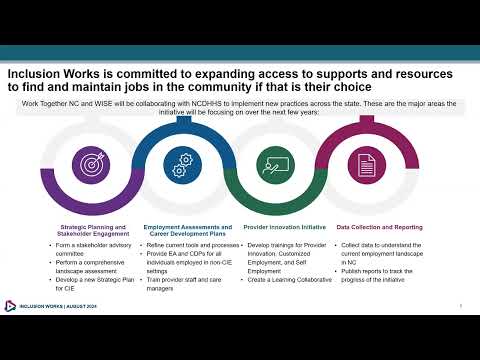
DHHS also confirmed the state is providing the funding and that tailored plans, vocational rehabilitation (EIPD) counselors and local management entities (LMEs) will be partners in assessments and administration. Mike Chapman of Work Together NC explained that the program includes a two‑step assessment: a preliminary employment assessment focused on informed choice and a career development plan for people who elect to pursue CIE; vocational rehabilitation may perform additional, separate assessments as part of that pathway.
DHHS said providers will receive lists of eligible members from tailored plans and that more detailed materials — including forms, a glossary of acronyms, and an FAQ — will be posted to the Inclusion Works web resources and shared by email. Monthly stakeholder meetings and periodic lunch‑and‑learns will continue to provide technical assistance and training.
The webinar concluded with a commitment to post the recording and slide materials, publish an FAQ addressing outstanding chat questions, and follow up on specific payment‑routing and operational questions raised by providers.