Get Full Government Meeting Transcripts, Videos, & Alerts Forever!
Get email alerts on the Local Elections topic
No spam. Unsubscribe anytime.
Skagit County District 3 candidates spar over farmland protection, battery storage and flood recovery at League forum
Summary
Incumbent Commissioner Joe Burns, challenger Connie Crier and former state lawmaker Keith Wagoner debated farmland preservation, a proposed battery energy storage site near Sedro-Woolley, housing and food insecurity, and post-flood recovery, outlining different priorities for permitting, public safety and county advocacy.
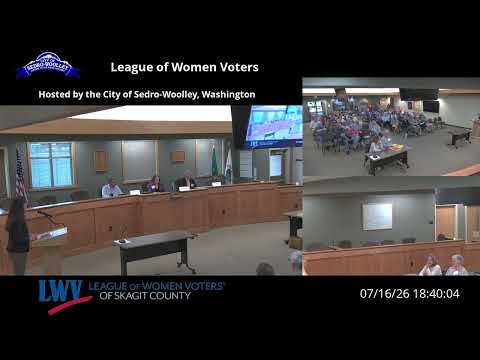
At a League of Women Voters forum for Skagit County Commissioner District 3, incumbent Commissioner Joe Burns and challengers Connie Crier and Keith Wagoner outlined competing approaches to farmland preservation, energy project review, housing affordability and flood recovery.
The forum opened with logistics from Jane Builders, president of the League of Women Voters of Skagit County, and ground rules from moderator Denayson Sakuma. The candidates each gave 90-second opening remarks and answered a series of questions from the moderator and the audience.
Burns, who said he was appointed earlier this year and currently serves as a Skagit County commissioner, emphasized transparency and fiscal prioritization. He described a three-tier system for county services (legal requirements, critical everyday services, then quality-of-life programs) and announced a new online budget portal intended to show residents how county dollars are spent. Burns said protecting farmland is a priority, praised the Farmland Legacy Program and said the commission has preserved about 150 acres since his appointment. On energy siting, he said the county must protect salmon habitat and cautioned against moving forward with large battery energy storage systems without scientific data; he said he had told a company proposing a facility near Sedro-Woolley that the county does not want that project sited there unless it provides written technical details.
Connie Crier, who identified herself as a board-certified safety professional and small-business owner, centered her answers on listening, prevention and process. She said emergency-management and fire-safety expertise should be included in advisory reviews of energy projects, warned that a poorly constituted advisory group erodes public trust, and called for after-action reviews and continuous improvement following the December floods. On housing and food insecurity, Crier argued the county should focus on removing permitting delays, target budgets to measurable outcomes, and measure success by how many people no longer need assistance.
Keith Wagoner stressed experience and his ability to secure state funding for local projects. He described his work on the state Ag and Natural Resources Committee and said he helped rally opposition to a setbacks proposal (referred to in the forum as the Lorraine Loomis Act). Wagoner said he has passed legislation in Olympia (he cited a figure of 26 bills) and argued the county should leverage state and local incentives to encourage multifamily housing investment and reduce regulatory barriers. On clean energy, Wagoner said he opposed lithium-ion battery energy storage systems near schools and farmland because of fire-related pollution risks and suggested hydrogen technology as an alternative; he also criticized the Climate Commitment Act funding mechanism, saying it had not reduced pollution and had raised fuel costs.
There were direct contrasts on disaster recovery and permitting. Wagoner criticized post-emergency recovery and state permitting rules that he said prevent preventative infrastructure work; Burns highlighted the need for clearer public information during emergencies (he described plans to display 100-year floodplain status more prominently on the county website) and raised concern about lengthy FEMA processing timelines that could leave temporary bridges in place for years. Crier emphasized preventing avoidable disasters and sharing after-action reviews publicly to improve response in future events.
Quotes that captured the tone of the night included Burns on openness: "I want county government to be transparent and accessible as possible because the public deserves to know how their money is spent." Crier on process and listening: "Good government doesn't silence disagreement. It creates a process people trust where voices are heard and real problems get solved." Wagoner on experience: "By any objective standard, I am that candidate," referencing his military and local-government background.
The forum did not include any formal votes or motions. Candidates repeatedly returned to the themes of pragmatic problem-solving and different emphases on when to use county authority versus state advocacy. The moderator reminded voters that primary ballots are due Aug. 4 and recommended mailing by July 28 to meet the deadline.
The League recorded the forum for later viewing on its website.