Get Full Government Meeting Transcripts, Videos, & Alerts Forever!
Get email alerts on the Municipal Fees topic
No spam. Unsubscribe anytime.
Caldwell staff propose fee restructuring that shifts most increases onto commercial developers; most residents would see small changes
Summary
Acting finance director presented a FY2027 fee-and-budget plan that would restructure utility charges using a cost-of-service analysis, raising connection and commercial rates while keeping most residential accounts at similar or lower bills; council asked staff for follow-up numbers before a Tuesday workshop.
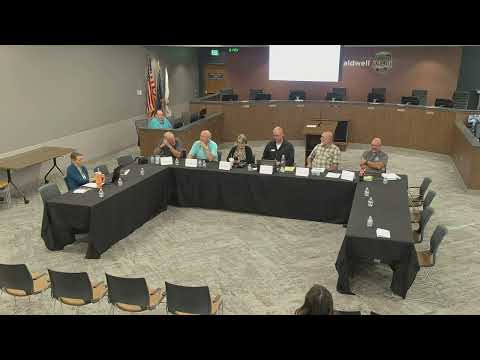
Acting finance director (name not stated) told the Caldwell City Council at a July workshop that the city’s proposed FY2027 budget is about $162,000,000 and that fee-related revenue would account for roughly $88.5 million of that total. “We have 162,000,000 in the budget currently for fiscal year 20 27,” the acting finance director said as she walked the council through the slides.
The presentation focused on a fee restructuring driven by a new cost-of-service analysis rather than simple inflation adjustments. “It was driven because we needed a cost of service analysis rather than just adjusting for inflationary adjustments,” the acting finance director said, adding that the most significant changes would affect connection fees paid by new development and larger commercial utility customers.
Staff showed that enterprise funds — including water, sewer, irrigation, sanitation, electrical and golf — make up the bulk of fee revenue, and that the proposed changes would increase utility-related revenue by roughly $21 million, mostly from sewer and water divisions. On a sample commercial invoice presented to the council, staff’s contractor analysis lifted an example water charge from about $130 to $271 and an example sewer charge from about $50 to $96.
For residents, staff said the restructuring is designed to align base fees with meter size and usage so that most households see modest impacts. The acting finance director summarized the projected residential distribution: about 75% of billed residential customers would have an overall monthly bill between $44.33 and $91.44; roughly 15% could fall in a $97–$124 band; and about 10% of high-usage residential accounts could see larger increases in the $130–$370 range. “Depending on your meter size… 75% will fall within that middle category,” she said, cautioning the figures are ranges based on usage and meter-size differences.
Sanitation, which is provided through a contract with Republic Services, would see a more modest, contract-driven increase (about 4.2% this year tied to CPI). Staff also proposed small changes across many building and permit fees (40 of 228 permit-related fees), modest adjustments at the Caldwell Event Center to improve cost recovery for cleaning, limited cemetery fee increases, and a roughly 5% across-the-board police-fee inflation adjustment.
Several councilors pressed staff for concrete examples and follow-up detail on which commercial customers would see the largest increases and on the city’s comparison to nearby jurisdictions. One council member asked for a short list of what the budget’s “other” revenue category includes; staff replied it is chiefly contractual and interagency reimbursements (for example rural-fire district agreements and infrastructure reimbursements).
Next steps: staff agreed to update the spreadsheet with the fee-revenue breakout and property-tax detail before the council’s next workshop. The council set a follow-up budget workshop for Tuesday, July 21, and asked staff to return with clarified numbers on connection fees, commercial impacts and the precise residential examples cited in the presentation.