Get Full Government Meeting Transcripts, Videos, & Alerts Forever!
Get email alerts on the Employment Services topic
No spam. Unsubscribe anytime.
EIPD outlines employment pathways and launches Project Spark pilot sites
Summary
North Carolina’s Division of Employment and Independence for People with Disabilities (EIPD) described a range of employment services—self-employment, on-the-job training, IPS, supported employment and Project SEARCH—and detailed Project Spark, a federal grant pilot to help people in subminimum-wage jobs pursue competitive employment.
Claire Colgan, IDD employment lead for the Division of Mental Health, Developmental Disabilities, and Substance Abuse Services, and Adrian Kittle, program specialist for IDD at North Carolina EIPD, used an Inclusion Works webinar to review EIPD services aimed at increasing competitive integrated employment for people with intellectual and developmental disabilities.
The presentation described the range of EIPD-supported pathways and a new grant-funded pilot called Project Spark that targets people in or considering subminimum-wage employment. "Our purpose is to help people with disabilities achieve their goals for competitive integrated employment and more independent living," Colgan said.
Adrian Kittle walked listeners through individual service options. For prospective entrepreneurs, EIPD offers self-employment services that start with business-plan development and referrals to local resources such as SCORE and the Small Business Development Center. Kittle said EIPD does not provide loans through this service and expects clients to contribute financially or in kind as part of eligibility and approval processes.
On-the-job training (OJT) was described as an employer-based training model in which EIPD can "reimburse the employer up to 75% of the client's agreed-upon wages" during a training period (typically up to three months), with the employer paying employment taxes and the remaining wage share. Kittle said successful completion of OJT normally leads to employer retention of the new employee.
Kittle outlined Individual Placement and Support (IPS) as a rapid-engagement, person-centered model for people with severe and persistent mental illness (16+). IPS uses a team that may include a team lead, employment professional, peer mentor and benefits counselor; funding for IPS is blended between EIPD and the tailored plans/LME/MCOs.
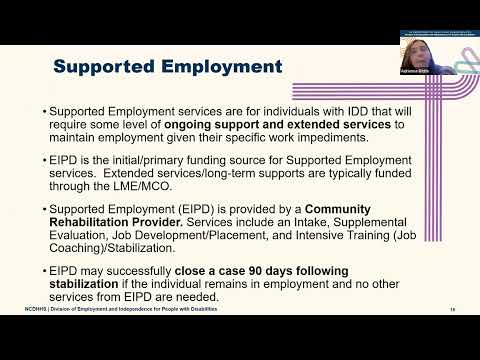
Supported employment was framed as the program for people with IDD who need ongoing job supports: EIPD typically provides initial funding and community rehabilitation providers supply job development, coaching and stabilization supports. Kittle explained that EIPD follows placements for at least 90 days to ensure stability before transitioning long-term supports to tailored plans and LME/MCOs.
Project SEARCH, a licensed national internship model that began in 1996, provides an intensive year of classroom instruction and three internship rotations with an employer host. Kittle said Project SEARCH aims for competitive integrated employment as the fidelity goal and noted that North Carolina currently has multiple secondary-education and adult Project SEARCH sites.
Project Spark received special attention: Kittle said EIPD was awarded a Rehabilitation Services Administration grant in fall 2022 and began pilot services in October 2023. The five-year grant (year three at the time of the webinar) funds community navigators, employment specialists, benefits counselors, peer mentors and administrative support; it also allows for wraparound community-engagement activities for participants moving from subminimum-wage settings into community jobs. Kittle listed the three Project Spark pilot sites and coverage areas: Chatham Trades (Siler City) serving Chatham, Orange and Lee counties; Tri County Industries (Rocky Mount) serving Nash, Edgecombe and Halifax counties; and Wake Enterprises (Raleigh) serving Wake, Johnston and Harnett counties. He said EIPD will work to transition services to tailored plans and LME/MCOs after the grant ends.
Kittle encouraged providers and employers to use local business relations representatives, employer trainings and EIPD website contacts to connect with inclusive-hiring resources. He also pointed attendees to Project SEARCH and EIPD websites for site-specific host lists and local office contact information.
The session concluded with the presenters directing attendees to posted slides and a recording, and with a reminder that the next Inclusion Works lunch-and-learn was scheduled for March 19.