Get Full Government Meeting Transcripts, Videos, & Alerts Forever!
Get email alerts on the Stormwater Regulations topic
No spam. Unsubscribe anytime.
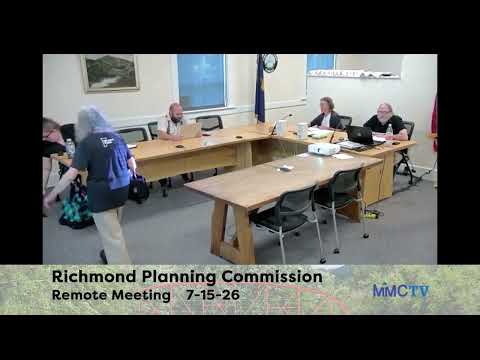
Richmond planning commission debates new stormwater rules, risk matrix and maintenance steps
Summary
At its July 15 meeting the Richmond Planning Commission continued work on three draft stormwater regulation approaches — including a streamlined 'current' Brooks draft and an Alternative 2 that inserts basic erosion- and stormwater-language into permit sections — and agreed to refine a two-step matrix to decide when professional engineering is required; no regulatory vote was taken.
Richmond — The Planning Commission on July 15 continued a months‑long effort to write local stormwater and erosion‑control rules, debating three alternatives and how to decide which projects must submit professionally engineered plans.
Commissioners, staff and guest drafters described three approaches: a Brooks 'current' draft that leans on the Vermont Low Risk Site Handbook as a baseline for all zoning permits; an 'original' proposal tied to existing major/minor site‑plan distinctions and a 600‑square‑foot trigger; and an Alternative 2 that would add modest erosion and stormwater requirements into the town's permitting sections and subdivision regulations. Chair opened the meeting noting materials from “Chelsea and Trevor Brooks” were marked current and would be compared with two other alternatives.
Why it matters: the rules determine whether routine homeowner projects (decks, driveways, small garages) remain simple and self‑administered or require engineered plans and long‑term maintenance obligations. Commissioners said the changes would affect homeowners, developers and the zoning office’s workload and stressed a need for both clarity and administrability.
The commission focused on a two‑part matrix the staff and drafters proposed. The first matrix is intended to decide whether an applicant must provide a professionally prepared erosion‑prevention or stormwater‑management plan; draft numbers discussed included placeholders ranging from a few hundred square feet up to 20,000 square feet (Trevor Brooks said 20,000 is roughly half an acre and was chosen as a provisional figure). The second matrix would assess post‑construction stormwater impacts (impervious area, lot size, proximity to neighbors) to determine longer‑term stormwater management needs.
Several points drew sustained debate. One school of thought — reflected in Chelsea Brooks’ draft marked “current” — would require every project that triggers a zoning permit to meet baseline practices from the Vermont Low Risk Site Handbook, even for very small disturbances. Opponents worried that a no‑threshold approach would burden trivial projects and asked whether a numeric floor (600, 400 or even 200 square feet) should exempt the smallest work. Commissioner Mark Vowsell warned that leaving too much discretion to individual zoning administrators risks inconsistent treatment across applicants; he said standards can "eliminate those variables" and reduce the perception of bias.
Commissioners and staff discussed where to place new language in the regulations. Staff favored putting requirements in the permitting section so the DRB and zoning office find them during routine reviews, while others suggested a freestanding guidance section would be easier to develop and test first. The commission also discussed shifting design guidance: subdivision rules previously used a 25‑year design storm; a draft change to a 10‑year design storm for certain provisions drew questions about sizing and practicability.
Enforcement and long‑term maintenance were recurring concerns. Members agreed erosion‑and‑sediment controls during construction are the easiest to require and enforce; longer‑term stormwater practices (rain gardens, detention, buried containers) raise maintenance and monitoring questions. Several commissioners proposed recording maintenance obligations with town land records so they appear in title searches; staff and others cautioned that deed‑recording and compliance could create administrative burdens and require legal and staffing capacity.
Commissioners also discussed practical support: training for zoning staff, a limited town‑engineer consulting pool, and simplified pamphlets or checklists (for example, a one‑page silt‑fence guide) that would reduce the burden on homeowners and administrators.
No formal vote was taken on the regulatory text. The commission agreed on next steps: refine the two matrices, test them against recent permit examples to see how they would apply in practice, keep basic ENS (erosion prevention and sediment control) expectations in the permitting language, and return with tightened draft language for additional review. The commission adjourned unanimously and scheduled its next meeting in three weeks.
"Perfection is the enemy of good," one participant said, urging the commission to adopt an effective, administrable baseline rather than delay for exhaustive detail. The next meeting will focus on matrix refinement and sample permit testing.