Get Full Government Meeting Transcripts, Videos, & Alerts Forever!
Get email alerts on the Ballot Order topic
No spam. Unsubscribe anytime.
Commission draws ballot order for charter amendments, solicits volunteers for pro/against committees
Summary
In a publicly conducted lottery the commission set the order for proposed charter amendments on the ballot and recorded commissioners who volunteered to serve on pro and con committees; staff explained the auditor’s role and contact information requirements for the voters’ pamphlet.
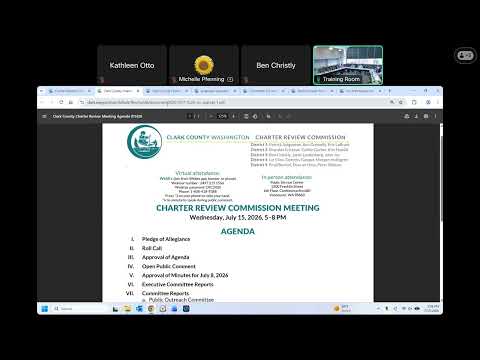
The Clark County Charter Review Commission conducted a public lottery July 15 to determine the order in which proposed charter amendments will appear on the ballot. Secretary Garber and Chair Erickson pulled numbered tiles and the commission read the placement: appearing first on the ballot will be amendment 26‑20 (limitation on consecutive terms for county council members); second will be 26‑10 (revised budget transparency and process); third will be 26‑23 (revised council powers regarding boards and commissions); the list continued through the tenth slot (26‑31, ethics review commission composition) as announced from the lottery results.
Following the draw the commission discussed guidance for 'for' and 'against' committees. Secretary Garber explained Elections/Auditor procedures: committees are not formal extensions of the commission; the auditor’s office will accept committee contact information, typically list up to three names per side in the voters' pamphlet, and requires at least one phone number or email address that will be published. The auditor’s office will contact listed committee members and the committees themselves determine chairs, campaign websites and how to coordinate outreach; committees must not use public resources.
Commissioners volunteered for 'for' and 'against' committees for individual amendments; the commission recorded those volunteers to pass to the elections office. For several measures the commission reported no commissioners volunteered to be on the opposing committee and staff indicated citizens would be recruited instead. No formal vote was required to record volunteers; the lottery and volunteer list were entered into the meeting record.