Get Full Government Meeting Transcripts, Videos, & Alerts Forever!
Get email alerts on the Planned Development Districts topic
No spam. Unsubscribe anytime.
Stratford housing partnership hears consultant on planned development districts, mayor urges corridor-focused growth
Summary
The Stratford Housing Partnership met to introduce planner Francisco Gomez and to discuss using a planned development district (PDD) to encourage mixed‑use, transit‑oriented housing along Main Street and Paradise Green; the mayor and staff said they will coordinate scope with the Connecticut Municipal Development Authority (CMDA).
The Stratford Housing Partnership approved minutes, introduced consultant Francisco Gomez and spent most of its meeting on planned development districts as a tool to boost housing choices in town.
Francisco Gomez, a planner with IMEC, told members a PDD is a “floating zone” enabled by Connecticut statute that lets the town create area‑specific regulations, permit multi‑phase approvals and allow higher‑density or mixed‑use development tailored to neighborhood goals. “It’s a very powerful tool,” Gomez said, describing how a master plan and legislative rezoning can precede final design and site approvals.
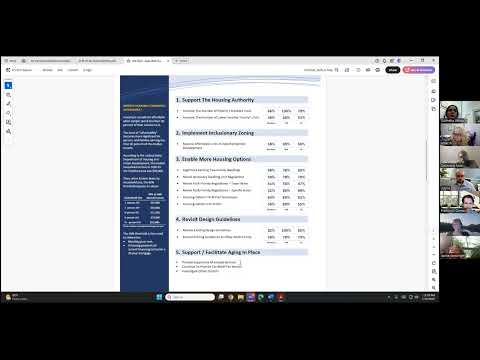
The partnership heard an executive summary of the group’s 2021 housing strategies that highlighted senior housing as a top priority and recommended a range of tools — from accessory dwelling units as‑of‑right to smaller‑scale “middle housing” and funding exploration — to expand options for residents who want to downsize or who are priced out of the local market.
Mayor Ches said he sees the PDD as a way to steer development to main corridors such as Barnum and Main Street, to expand transit‑oriented development near the train station and to create walkable, mixed‑use places around Paradise Green. “We need to make it easier for developers to develop where we want the development,” Mayor Ches said, calling for protected bike lanes, retail on ground floors and housing above. He cited the Temple Court building redevelopment as an example — “we’re gonna be putting up 60 units there,” he said — and said CMDA could provide technical help and gap financing.
Susmita (staff) said town staff will coordinate the scope of work and technical assistance with Francisco’s team and with the Connecticut Municipal Development Authority to avoid duplication; she said she is awaiting CMDA’s response on their potential scope. Francisco emphasized that drafting PDD regulations should be a workshop process that involves planning and zoning commissions and other stakeholders, and that even after regulations are adopted the planning and zoning commission retains legislative discretion to deny rezonings it deems inappropriate.
New partnership member Jackie, who described herself as a real estate professional, urged the group to prioritize multifamily housing and asked for more detail on the senior population findings. “It is a real problem in housing. It’s a human right,” Jackie said, arguing that multifamily units can provide ownership pathways and increase inventory.
The meeting ended with members agreeing to refine the consultant scope, coordinate with CMDA and proceed with workshops to shape possible PDD regulations. No formal zoning changes were proposed or adopted at the meeting; next steps are staff coordination and outreach to planning and zoning for a drafting process and public hearings.
Notes: participants discussed CMDA and a claimed funding pool; Mayor Ches said CMDA has “about $115,000,000” for community development and gap financing. Members used the term “Paradise Green” for a downtown area; the transcript also includes the variant “Paradise Screen.”