Get Full Government Meeting Transcripts, Videos, & Alerts Forever!
Get email alerts on the Land Use Annexation topic
No spam. Unsubscribe anytime.
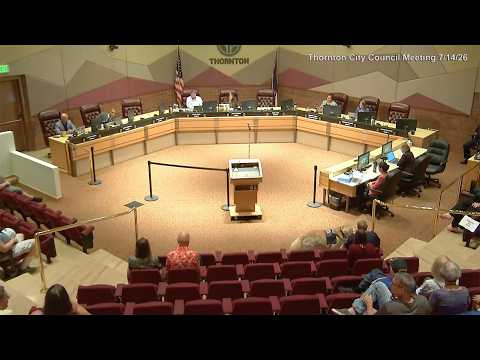
Thornton council unanimously approves Sunrise annexation, zoning and metro district service plan
Summary
The Thornton City Council approved annexation, zoning, a conceptual site plan for about 87 acres south of East 120th Avenue, and a conditional service plan for the Thornton Sunrise Metropolitan District, clearing the way for roughly 199 single-family homes and related infrastructure. Council and staff discussed traffic, buffers around existing radio towers and metro-district financing.
The Thornton City Council voted unanimously to approve a package of actions allowing the Sunrise development to proceed on roughly 87 acres south of East 120th Avenue and east of Holly Street.
The actions included a findings resolution, first-reading approval of the annexation and zoning ordinances, a resolution approving the conceptual site plan and a conditional approval of the metropolitan district service plan and related intergovernmental agreement. Staff said the plan would yield about 199 single-family detached homes, a gross density near 2.3 dwelling units per acre and a series of landscaped buffers around four existing radio towers that will remain in place.
City staff and the applicant presented details of the proposal at the hearing. Senior planner Kara Stoller described the site as three parcels currently in unincorporated Adams County and summarized that the proposal includes neighborhood parks, trail connections to Skylake Ranch and Mayfield, and a central neighborhood park with a splash pad. Planner Elise Applegate Klink said the PUD limits the project to a maximum of 3 units per gross acre and that the applicant’s plan falls below that maximum. She also noted 40-foot buffers on the south and west edges and an eastern buffer comprised of easements totaling about 100 feet where no construction is planned.
The applicant’s traffic analysis projects the development would generate about 1,877 vehicle trips on an average weekday, with roughly 139 inbound/outbound morning peak trips and about 187 in the evening peak. Applegate told council that Thornton traffic staff has already determined the intersection of 117th Avenue and Holly warrants a traffic signal; the development will contribute funds toward signal construction if a signal is required at 120th and Locust in the future. City traffic engineer Matthew Koenig said design work is underway and that signal-pole procurement can take four to six months; he estimated a typical signal project can be completed for under about $450,000 depending on complexity.
The service plan for the proposed Thornton Sunrise Metropolitan District would authorize the district to finance, construct and maintain public improvements for the neighborhood. Attorney Matt Ruhlin, representing the applicant, said estimated public-improvement costs are just north of $14.4 million and the service plan would authorize up to $15 million of debt. He emphasized the district is an independent local government that would issue its own debt and that there is no obligation for the city to cover those costs; any shortfall in district financing would be borne by the developer.
Teresa Alvarez, president of the Skylake Ranch Phase 3 homeowners association, testified in favor of the proposal and told council the developer had worked with neighbors to modify trail alignments and commit to the 40-foot buffer. After questions from council, including on access, fencing and tower setbacks, council members moved and seconded the recommended actions. The findings resolution, annexation and zoning ordinances (first reading), conceptual site plan resolution, and the conditional approval of the metro district service plan and IGA were all approved unanimously.
Next steps noted by staff include the developer proceeding to development plan, residential design review and subdivision plat processing; the annexation ordinance was presented with a requested deferred effective date of 60 days following second reading to allow the developer time to complete property purchase.