Get Full Government Meeting Transcripts, Videos, & Alerts Forever!
Get email alerts on the Sustainable Energy District topic
No spam. Unsubscribe anytime.
Infra pitches Clinton Sustainable Energy District to Little Rock board
Summary
Infra representatives proposed creating a downtown Clinton Sustainable Energy District that would centralize heating and cooling, monetize city thermal assets via an "energy as a service" concession, and finance $18.5 million in deferred maintenance while guaranteeing utility savings.
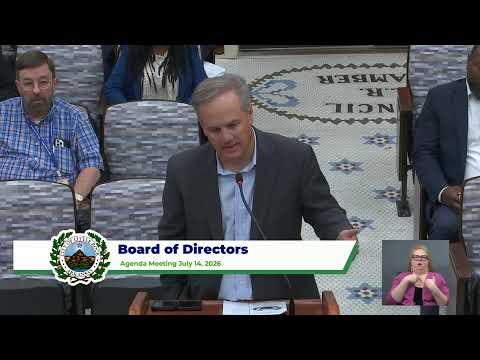
At a July 14 meeting of the Little Rock Board of Directors, Infra representatives Jordan Tinsley and Ed Tinsley outlined a plan to build a Clinton Sustainable Energy District that would centralize the production and distribution of heating and cooling to municipal, nonprofit and private buildings downtown.
The proposal would use an "energy as a service" concession: Infra would pay the city an advance for the right to use existing thermal assets — chillers and boilers — while the city would retain book and title ownership. Jordan Tinsley, vice president of development at Infra, described the arrangement as a concession, not a sale: "This is not a sale of the assets. ... we are acquiring a concession of the assets," he said.
Why it matters: Infra said the transaction would address roughly $18,500,000 in capital renewal and deferred maintenance, improve reliability during power outages, and create operating efficiencies. Ed Tinsley, an advisor to Infra, said the improvements are anticipated to lower utility costs "for roughly $3,500,000 a year" and that the company will "guarantee that million dollar reduction" through measurement and verification systems.
How it would work: Infra proposes to interconnect mechanical plants at the Clinton Presidential Center, the Robinson Center, the State House Convention Center, City Hall, the annex, the Museum of Discovery and the Ottenheimer Market Hall into a looped chilled- and heating-water network. The company said it would install metering, analytics and generators to allow the city to take interruptible electric service where financially advantageous.
Accounting and oversight: Infra presented an accounting outcome it said would avoid placing debt on the city's balance sheet — an upfront advance treated as operating revenue recognized ratably while ongoing thermal-service payments would be operating expenses. Infra said it has reviewed the approach with the city's auditor (Forbus) and with rating agencies; Ed Tinsley cited Governmental Accounting Standards Board guidance as the relevant authority on valuation and recognition.
Open questions and timeline: Board members asked how the advance payment amount would be determined; Infra said the fair value is calculated using a detailed economic model of potential off-taker revenues and would be validated by the city's financial adviser and auditor. The companies said some scope remains in flux, including a recently failed second chiller at the Robinson Center that may change pricing. Ed Tinsley said next steps include ordinance approval for a sole-source procurement with Infra, validation of scope and financial outcomes, negotiated contracts, and required approvals. He gave an indicative timetable with a potential financial close as early as 2026-11-01 and a commercial operation date of 2026-12-31, with roughly two years for design, construction and commissioning thereafter.
City workforce and guarantees: Infra told the board it intends to supplement, not replace, the city's operations staff, with an on-site asset manager coordinating operation and maintenance. On performance, Infra described daily measurement and verification and an annual reconciliation process in which the company would cut a check if guaranteed savings fall short.
What's next: The board was told that no action would occur before the board approved terms, and that the exact advance payment figure would be shared with the board after review by the city's advisers. The item will return as an ordinance request to allow sole-source procurement and to continue financial and legal validation.