Get Full Government Meeting Transcripts, Videos, & Alerts Forever!
Get email alerts on the Local History topic
No spam. Unsubscribe anytime.
Nancy Gray recounts Outer Banks commercial-fishing history and local characters
Summary
At an Outer Banks storytelling session, Nancy Gray traced the region's commercial-fishing evolution—from early salt-and-smoke preservation to 20th-century expansion aided by ice and rail—and urged support for fishing as a living tradition under pressure from regulation and recreational competition.
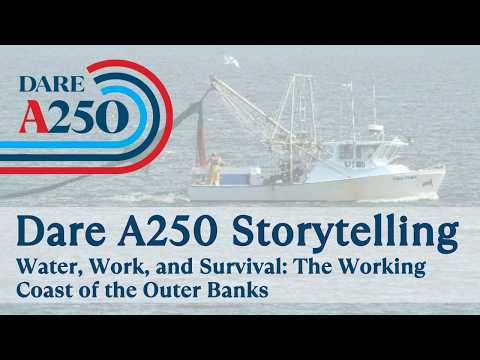
Miles Daniels, moderator, opened the afternoon storytelling session and introduced Nancy Gray, who spent the next half-hour telling personal and community stories about commercial fishing on the Outer Banks.
Gray said the history begins in small family operations and wharves. "My late husband...ran the Old Wharf for over 60 years," she said, and she recounted how men and families worked nets from the beachfront and sold fish locally or through companies that connected Dare County catches to wider markets. She noted that the Globe Fish Company began in the early 1900s and that the arrival of ice—first shipped from Maine, later produced at local ice plants—transformed preservation and distribution to places such as Elizabeth City and New York's Fulton Fish Market.
The talk emphasized technical and cultural change. Gray described a mid-20th-century heyday when harbors were dredged and boats could go farther, and she credited local innovation—boat rigging adaptations, new fisheries (swordfish, scallops, squid) and connections to out-of-state fishermen—with opening markets. "We were the first restaurant to serve fried squid," she said, telling how a local restaurateur introduced new tastes that later became markets for local catch.
Gray also highlighted the human risks of the trade: long hours, no guaranteed income and the danger of storms. She said that regulations and the expansion of charter and recreational fishing can further squeeze commercial fishermen. "We can still have commercial fishing without regulating it out of existence," she said, urging education of representatives and respect for the fishermen's heritage and livelihoods.
The session closed with Gray's takeaway: commercial fishing is a vital way of life and an industry that should not be disregarded. Daniels thanked Gray, pointed audience members to the bookstore that carries her books, and announced the next storyteller.