Get Full Government Meeting Transcripts, Videos, & Alerts Forever!
Get email alerts on the Strategic Planning topic
No spam. Unsubscribe anytime.
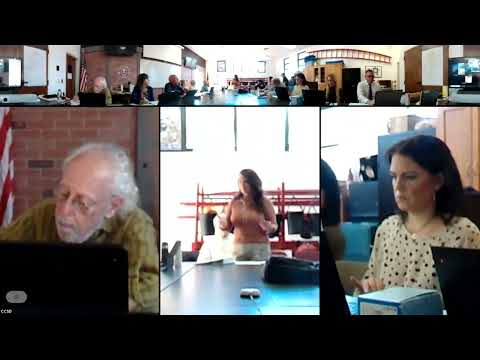
Cambria board holds strategic-plan workshop as staff warns of tight budgets and urges funding clarity
Summary
The Cambria Community Service District held a full-day strategic-plan workshop March 2, 2026, where staff argued the district must prioritize water, wastewater and fire services, align discretionary projects to funding, and asked the board to form an ad hoc to study alternative revenue sources.
The Cambria Community Service District board held a strategic-plan workshop March 2, 2026, to revise goals, revise timelines and align resources. President Terry Farmer opened the meeting and General Manager Matthew McElhinney laid out a five- to ten-year planning window and asked the board to focus on measurable objectives and supporting actions.
Staff framed the central choice facing the district as one of prioritization: because enterprise funds (water and wastewater) are legally restricted, and the general fund is limited, the district must sequence projects and identify funding before committing to discretionary amenities. "Every major investment must be sequenced, rate justified, grant leveraged, or financed responsibly," McElhinney said, urging the board to treat water reliability, wastewater integrity, fire suppression capability and backup power as the top priorities.
The facilitator and board spent the day reviewing mission, vision and core values and walking through objective-by-objective edits. Staff noted recent permitting progress on the wastewater recycling facility (WRF) but cautioned the district still faces significant operating and capital constraints. Several public commenters—including Dennis Ducek and Tony Stafford—pressed the board to set concrete deadlines for water supply research, flood and fire hazard reduction, and to prioritize defensible-space maintenance.
On discretionary projects such as a community park and a skate park, staff repeatedly emphasized that moving forward without a dedicated maintenance or funding mechanism would shift limited staff time and general-fund dollars away from legally required services. "We can't keep going making small commitments that eat up essential funding for fire protection," one board member said during the discussion.
As a near-term governance step, board members agreed to form a small board ad hoc to investigate alternative revenue sources and report back with options for how to fund discretionary projects or to restrict them if funding cannot be identified. The meeting closed with recognition of staff work and a reminder that many implementation decisions will be funding-dependent and require further board action.
The board did not take final votes on policy changes at the workshop; several objectives were adjusted and assigned target timelines to be revisited with more granular cost estimates and supporting actions.