Get Full Government Meeting Transcripts, Videos, & Alerts Forever!
Get email alerts on the Housing Element topic
No spam. Unsubscribe anytime.
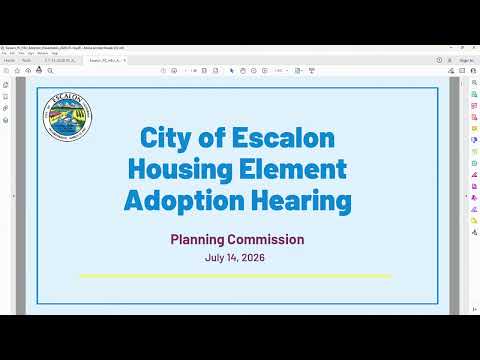
Escalon Planning Commission recommends City Council adopt 2023–2031 housing element, advances zoning changes under SB 4
Summary
After a detailed presentation and questions about compliance risks, the commission voted 5–0 to recommend that the City Council adopt Escalon's 2023–2031 housing element and forward a package of zoning text amendments — including a religious institution overlay to codify SB 4 — for council hearings in August.
The Escalon Planning Commission voted unanimously on July 14 to recommend that the City Council adopt the city's 2023–2031 housing element and to forward a package of zoning text amendments intended to secure full certification by the state Department of Housing and Community Development (HCD).
Consultant Luke of 4Leaf told the commission the housing element document had "substantially met the requirements of housing element law" and that adopting the accompanying zoning changes was necessary to achieve full certification. He said the city submitted the final subsequent draft to HCD in April and "received that conditional compliance letter on June 26," and staff intends to submit the housing element and zoning amendments concurrently to streamline the review.
The update assigns Escalon a regional housing needs allocation (RHNA) of 367 units and relies on a mix of pipeline projects, accessory dwelling unit (ADU) projections and identified vacant and religious‑institution sites to meet that allocation. Luke summarized the accounting: pipeline projects account for 225 units and ADU/JADU credits were estimated for additional credits, leaving a sites strategy that includes vacant parcels and a set of church‑owned parcels to provide a buffer against “no net loss” requirements under state law.
Commissioners asked staff about the consequences of failing to adopt the element. Luke warned of potential enforcement and fiscal penalties, saying the attorney general, on referral from HCD, has "the latitude… to issue fines on the city of Escalon, ranging from $10,000 to $50,000 per month" for continuing noncompliance. Staff said they were confident the document was substantially compliant and that the remaining step was adopting the zoning amendments.
Key implementation items in the zoning package include a religious institution overlay (RIO) to codify provisions of Senate Bill 4 (SB 4), updates to parking standards to align with state density bonus and unbundled parking rules, and further zoning for housing types required by state law (permanent supportive housing, low‑barrier navigation centers, employee housing, residential care facilities and manufactured housing). Luke described the RIO as a mechanism to ensure church parcels identified in the sites inventory could be used to support the RHNA without requiring base‑zoning changes.
Staff said the churches on the three identified parcels had been notified and had participated in outreach. The commission pressed staff on whether a church would automatically get overlay benefits for land it purchased after a fixed cutoff; staff clarified that SB 4 protections generally apply only to land owned by a religious institution prior to the statute's date thresholds and that any expansion onto newly acquired land would require a separate zoning or general plan action to extend overlay rights.
The planning commission formally recommended council adoption of the housing element and the accompanying zoning amendments. City Council is scheduled to take up the housing element and the zoning package at a special meeting on Aug. 10, with a second reading of the zoning amendments tentatively set for Aug. 17. HCD will have up to 60 days for final review after submittal, though staff said review often takes less time when documents are submitted in this position.
The commission's vote advances the city's compliance with state housing law and begins the local process to implement the element's quantified programs and timelines.