Get Full Government Meeting Transcripts, Videos, & Alerts Forever!
Get email alerts on the Building Codes topic
No spam. Unsubscribe anytime.
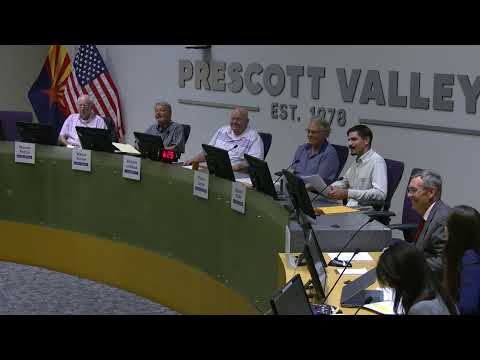
Prescott Valley board reviews proposed 2024 building codes; members press fire district on amendments
Summary
The Prescott Valley Building Board of Appeals held a public hearing on adopting the 2024 International Code Council model codes, heard questions about shipping-container homes and higher insulation and electrical requirements, and sought clarity on CAFMA fire-code amendments and homeowner cost impacts.
The Prescott Valley Building Board of Appeals on July 2026 held a public hearing to review the town’s proposed adoption of the 2024 International Code Council model codes, including the International Building Code, International Residential Code, plumbing and electrical codes, and related standards. Staff said the town will adopt most 2024 code editions but will move to the 2012 energy code rather than the newest energy edition.
"All of the 24 codes except the energy code," said Russ Harsh, senior plans examiner, explaining the town’s proposed package and the goal of aligning local rules with county jurisdictions while protecting public health and safety. Harsh told the board the update aims to keep rules consistent across the region and limit abrupt cost impacts for builders.
The presentation listed several notable technical changes. Harsh said the 2024 cycle adds a live/work unit category, elevated PV (solar) support provisions for structures such as parking, and explicit language addressing intermodal shipping-container structures. He described a new smoke-alarm requirement that calls for an alarm when there is a 24-inch height difference between levels, and said vapor barriers will be required when specified by a geotechnical report. "A surge protector for the whole house is now a requirement," he added, and the electrical code increases GFCI and arc-fault protections.
Harsh also described higher insulation targets: ceiling insulation moving from roughly R-38 to R-49 and wall assemblies transitioning from R-13 to about R-30 (or an equivalent assembly). He framed those changes as incremental and not expected to dramatically raise construction costs, citing industry comparisons between prior code cycles.
Public attendees asked practical questions. One resident asked how difficult it would be to permit a shipping-container home; Harsh said projects that stay within prescriptive code limits generally do not require extra review, but proposals that exceed prescriptive parameters would need a structural engineer and additional scrutiny. "If you stay within what the code says ... there shouldn't be an issue," Harsh said.
Stacy Bristow, development director, said planning staff are updating design guidelines and will coordinate review of setbacks, landscaping and other zoning issues if a factory-built or shipping-container proposal is submitted. "We look at these as we go forward ... planning would look at it," Bristow said.
Board members raised questions about CAFMA, the regional fire authority, and whether CAFMA’s amendments to the fire code could add requirements that increase builder costs. Chair Richard Leathhead described instances where fire-related requirements had increased construction costs and asked what control the town would retain. Staff and other board members said Prescott Valley operates under intergovernmental agreements with CAFMA, that CAFMA typically posts amendments on its website and conducts presentations, and that the town expects to receive and review CAFMA amendments and to coordinate through staff meetings and IGAs.
Staff highlighted one enforcement benefit of closer fire-code alignment: the ability to require automatic sprinklers for structures that exceed 5,000 square feet, an option the town previously lacked to force retroactive sprinkler installation on large additions. At the same time, a board member noted that recent state legislative changes have constrained some local requirements, creating a tension between affordability and safety mandates.
The board closed the public hearing after hearing testimony and questions; staff emphasized that the meeting was an opportunity for informal input and that no formal board vote on code adoption was required at the session.
The board asked staff to provide any CAFMA draft amendments, presentations or links for further review, and staff offered to bring CAFMA representatives or materials to a future meeting for detailed discussion.
Next steps: staff will collect comments, share CAFMA materials when available, and allow the board opportunity to review specific CAFMA amendments before any town adoption action.