Get Full Government Meeting Transcripts, Videos, & Alerts Forever!
Get email alerts on the Comprehensive Plan topic
No spam. Unsubscribe anytime.
Mount Vernon planning forum: residents push for farmers market, clearer forestry rules and stronger lake protections
Summary
At a public forum hosted by the Mount Vernon comprehensive planning committee, residents and local stakeholders urged the town to preserve rural character while improving outreach for farmers, reconsider local forestry rules versus statewide standards, and update lake-protection language and monitoring in the towns draft plan.
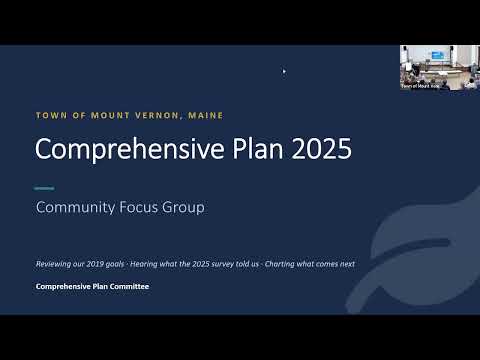
At a public forum, the Mount Vernon Comprehensive Planning Committee asked residents for input as it combines a 2019 draft plan with results from a 2025 survey to update the towns comprehensive plan.
"We're glad that we're gathered tonight to get your input," said Kathy Jacobs, a member of the comprehensive planning committee, opening the meeting and outlining that an approved plan will be required for state grant eligibility and will guide budgeting and town project decisions.
Residents and local producers focused their remarks on three linked topics: agriculture and community food infrastructure, forestry regulation and support for landowners, and lake and watershed protections.
Several speakers pressed for a farmers market and related shared-kitchen resources as a way to support local producers. "A farmer's market would be really, really nice, but we don't have a place to do that," said Carrie Casey, a resident who spoke in favor of the idea. Organizers noted practical barriers including parking availability and possible deed or school-use restrictions; one longtime market organizer, who identified herself as Barbara, offered to help with planning and management.
Speakers also urged improved outreach and information for farmers. The committee and residents agreed on better communications about programs such as tree-growth and tax incentives and recommended a targeted welcome packet that lists resources and associations new landowners can use.
The meeting featured a pointed discussion about forestry oversight. Some residents recommended Mount Vernon adopt the statewide forestry standards so landowners can access state technical assistance and avoid duplicative local regulation; others defended Mount Vernons local steep-slope protections. "The only thing that we regulate in Mount Vernon relating to timber harvesting is either in the shoreland zone or it's on steep slopes," said Susan Herman, a member of the ordinance review committee, describing the towns existing steep-slope provisions and the local history that led to them.
Foresters and timber landowners warned that requiring costly professional site plans or routine planning-board review for many harvests can be prohibitive for small landowners and suggested the town provide clearer guidance and links to forester services instead of adding new regulatory layers.
Water and natural-resource protection drew extensive comment. Committee members recapped 2019 goals to protect lake and stream water quality, test waters, address runoff and road-related sediment, and prevent invasive species. Lydie Robbins of the 30 Mile River Watershed Association and other lake-group representatives urged updates to the plan to reflect which organizations perform monitoring and to incorporate recent legal changes.
Tom Arminio of the Greater Minnehunk Lake Association recommended explicitly referencing the 2023 "Clean Drain Dry" law that targets the spread of invasive aquatic plants and updating the plan's invasive-species lists. Residents also asked for clearer language about who is responsible for testing: the town typically monitors E. coli at public beaches under the health officer, while much of the routine water-quality monitoring is done by lake associations or volunteer programs; state DEP monitoring may occur on a multi-year rotation.
Speakers raised infrastructure fixes such as culvert surveys and road-runoff improvements as immediate steps the town could prioritize to reduce sedimentation. Residents also discussed managing Canada geese and beaver impacts, and asked the committee to consider protecting smaller wetlands and vernal pools that were not fully addressed in the 2019 draft.
Committee members asked attendees for specific edits and pledged to consult stakeholders when updating text and data. Anna (who identified herself as a resident) told the forum the committee plans another focused session in mid-August, with incorporation of comments to occur in late fall and winter and a public hearing and town vote to follow.
The committee did not take formal votes at the meeting; it will revise the draft plan and circulate updated language and data for additional review before presenting it to the select board and, eventually, town meeting for a vote.