Get Full Government Meeting Transcripts, Videos, & Alerts Forever!
Get email alerts on the Infrastructure topic
No spam. Unsubscribe anytime.
Council weighs closing Warrior Trail after ongoing truck‑parking violations on county property
Summary
Town staff reported a county‑owned truck‑parking/repair property along Warrior Trail has not complied with required dedication/mitigation and is damaging the town road; council discussed notices, Jersey barriers and a statutory 90‑day closure and asked legal staff to prepare options and schedule an executive session to evaluate enforcement and potential litigation.
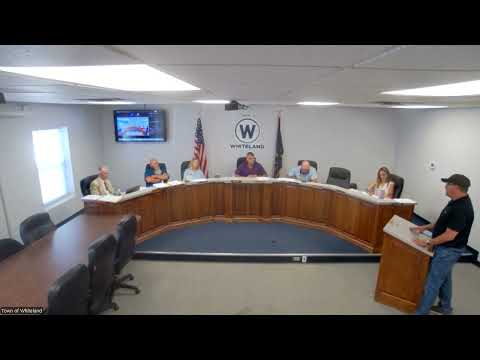
Whiteland staff told the council on July 14 that a county‑owned property at 5440 Warrior Trail used for truck repair and parking continues to violate terms discussed during a 2024 acceptance‑pending‑legal‑review, and the town is experiencing pavement damage and illegal parking and repair activity on its right‑of‑way.
Town manager Carmen said the owner has not completed required infrastructure (including a cul‑de‑sac) and noted heavy truck traffic has caused depressions and ongoing deterioration of the road. Staff warned that accepting the right‑of‑way remains pending and the town is not required to accept a failing road. Carmen said staff had discussed contacting the county and taking legal steps up to road closure to prevent further damage.
Council discussed enforcement options: written notice with a short compliance window, limiting truck traffic or adoption of an ordinance to close or narrow the road, placing Jersey (concrete) barriers to prevent truck turns, or temporarily closing the road for up to 90 days under statute. Fire and public‑safety staff cautioned that any closure must preserve emergency access; the fire marshal noted that closing the road could result in red‑tagging or restrictions if emergency access is compromised.
Several council members favored a firm approach to protect town infrastructure and suggested staff draft an ordinance and written notice. Town attorney Watson advised preparing options and, because of litigation risk, recommended the council discuss some steps in executive session with legal counsel present. The council directed staff and legal counsel to prepare legal options and to schedule an executive session in roughly three weeks to decide final steps.
Staff also reported interest from adjacent property owners (ABC Cutting) in seeing the town act and support for targeted barrier placement where appropriate; staff said they would coordinate with property owners to preserve legitimate access while preventing repeated damage.
No formal motion to close the road was taken at the meeting; the council asked legal and staff to prepare options for an executive session and an ordinance if necessary.