Get Full Government Meeting Transcripts, Videos, & Alerts Forever!
Get email alerts on the Data Centers topic
No spam. Unsubscribe anytime.
Purdue faculty member briefs DeKalb County plan commission on data centers, urging careful negotiation
Summary
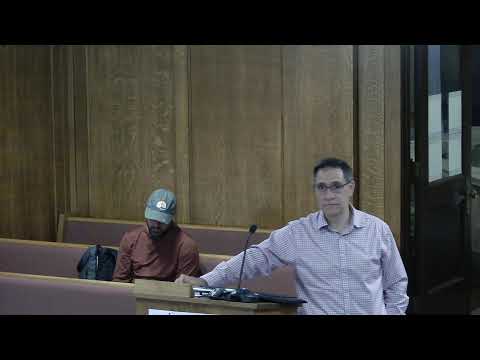
At a July 15 DeKalb County Plan Commission meeting, Purdue faculty member Roberto Gardo outlined energy, water, noise and e‑waste risks from hyperscale data centers and urged the county to use community benefits agreements and technical review while its moratorium remains in place.
A Purdue faculty member told the DeKalb County Plan Commission on July 15 that data centers represent a new class of large investments with significant tradeoffs and that local leaders should negotiate aggressively to protect community interests.
"Let me just start by saying that this is massive, folks," said Roberto Gardo, who identified himself as a Purdue faculty member speaking on regional and rural development. Gardo framed data centers as a category that ranges from small edge facilities to hyperscale sites and said the hyperscale facilities are the ones straining electricity and water systems.
Gardo described energy as the top concern, noting that data centers already consume a nontrivial share of U.S. electricity and that continued build‑out could increase that share substantially. He told the commission that a recent state law requires data centers to shoulder much of the cost of grid upgrades, saying "80% of the costs of upgrading the grid ... to be paid for by the data center themselves," and advised the commission to verify such requirements on a case‑by‑case basis.
Water and cooling were likewise raised as pressing issues. Gardo said closed‑loop cooling and emerging non‑water cooling methods can reduce water use, but he recommended commissioners ask prospective developers for projected water demand, source, and whether systems are closed‑loop. He also pointed to noise and generator emissions as community concerns and noted anecdotal reports of a persistent low‑frequency hum near some facilities.
On long‑term risks, Gardo flagged electronic waste and the potential for changes in technology or demand to leave large, specialized facilities underused. "You have got to ask those questions to the developers ... who's gonna take care of the e‑waste?" he said, urging communities to require clear disposal and reuse plans.
Gardo emphasized that economic outcomes vary by local tax structure and negotiation: some jurisdictions have captured significant tax revenue or benefits, while others saw relatively few permanent jobs compared with past manufacturing projects. He recommended community benefit agreements to secure targeted investments such as workforce programs, community funds and school support.
Commissioners asked about examples elsewhere, siting, and why some large projects fail. Residents and commissioners cited a nearby large proposed project that collapsed when a utility could not provide the needed power; Gardo agreed that grid capacity and upgrade costs commonly determine whether projects proceed.
The commission discussed the county's moratorium on data‑center permitting and the work underway to draft an ordinance. A commissioner reported that city staff plan to request a public hearing on the unified development ordinance for Aug. 11 to review zoning and land‑development rules.
The meeting also handled routine business: the commission tabled two sets of minutes and approved claims by voice vote. The commission adjourned after public comments thanking staff for arranging the presentation.
The Plan Commission did not take formal action on data center siting or incentives at the meeting; commissioners were advised to assemble technical and legal expertise (utilities, engineers and counsel) to evaluate specific proposals and to keep public transparency when negotiating community benefits, should developers approach DeKalb County.