Get Full Government Meeting Transcripts, Videos, & Alerts Forever!
Get email alerts on the Zoning Variance topic
No spam. Unsubscribe anytime.
Enfield zoning board denies variance request for Woodberry Farm cottage development
Summary
After extended testimony from the applicant, a land-use attorney and dozens of residents, the Enfield Zoning Board voted to deny a variance that would have allowed multiple principal buildings on the Woodberry Farm parcel; the board cited density, wetlands concerns and community feedback.
The Enfield Zoning Board on the night considered a developer’s request to allow multiple principal buildings on a large parcel known in the record as Woodberry Farm and voted to deny the variance sought to permit the project’s cottage-style layout.
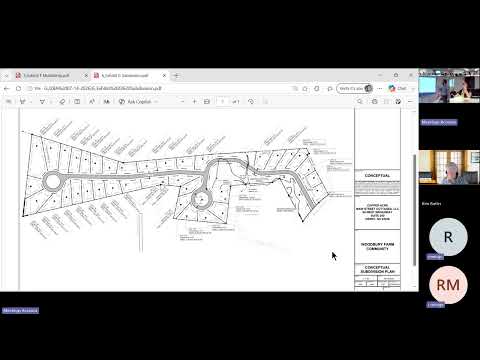
Applicant Adam Brown presented supplemental exhibits and two illustrative alternatives the board had requested: a by‑right single 65‑unit apartment building and a conventional subdivision. Brown said the development team prefers a cluster of smaller cottages and argued the variance would allow a design that "we don't want to build a bunch of units in 1 building" and instead would have "less density, but spread over multiple rooftops." He and his land‑use attorney, Kim Butler, said the proposal intended to preserve mature trees and limit wetland impact, and that state and town permitting (including any NHDES dredge‑and‑fill review and a wetland special exception) would be required before any wetland work.
The attorney for the applicant told the board that variance law allows relief where strict application of a zoning provision would be unduly confiscatory or produce an unreasonable result, and urged the board to weigh whether denial would serve the public interest given the parcel’s configuration and the alternatives the applicant showed.
Residents who spoke during the public‑comment period urged the board to deny the variance or to limit any approval. Nicole Lovejoy, who lives on Main Street, said she remained "very concerned about the density" and cited potential impacts to property values, trees and privacy. Other neighbors raised questions about sewer hookups and emergency access, asked whether the planning board had reviewed the larger 38‑unit concept and warned the development could alter the neighborhood character. Supporters who spoke said the cottage approach could bring foot traffic to downtown businesses and add housing needed in the village core.
Board members spent extensive time walking through the variance criteria: public interest, spirit of the ordinance (harmonious development), substantial justice, property values, and hardship. Several members said they appreciated the quality of the presentation but remained troubled by the proposed number of units and by outstanding technical questions about wetlands and infrastructure. One board member said it was not the board’s role to maximize the applicant’s profit and noted the applicant had alternatives available that would not require the same variance relief.
A motion to deny the variance was made and seconded; the board voted to deny the request. (The motion to deny was moved by a board member identified in the transcript as speaker 8 and seconded by speaker 10. The board recorded ayes and nays and the motion carried.)
What happens next: with the variance denied, the applicant may revise the proposal and could return to the zoning board or pursue alternatives that conform to the ordinance or that require different permitting steps — including a separate special exception if wetlands impacts are proposed. The transcript shows the applicant acknowledged several next steps remain, including further delineation of wetland boundaries, soil studies and traffic/driveway permits under state jurisdiction for access on Main Street.
The board closed deliberations after recording its findings and the vote. No final building permits or wetland permits were granted that night.