Get Full Government Meeting Transcripts, Videos, & Alerts Forever!
Get email alerts on the Zoning Ordinance Amendments topic
No spam. Unsubscribe anytime.
Arlington zoning committee reviews amendments to allow temporary telecom support structures and shorten some appeal periods
Summary
The Zoning Ordinance Committee on July 16 reviewed three targeted amendments to implement a new Virginia law creating temporary telecommunication support structures, to clarify pre‑application fee and delinquent tax authority, and to allow a 10‑day appeal period for certain civil‑penalty notices; staff will advertise the changes and return with refined language.
The Arlington Zoning Ordinance Committee on July 16 heard a staff presentation on three targeted changes to the county zoning ordinance intended to align local rules with recent amendments to the Code of Virginia.
Lindsay Klein of the county Zoning Division told the committee the package responds to new state law and corrects an omission from an earlier local update. "It introduced a new subtype of telecommunication facilities called temporary telecommunication support structures," Klein said, noting the state law became effective July 1 and requires localities to explicitly allow and define those temporary, non‑permanently installed structures.
The proposed local text would add a definition for the temporary telecommunication support structures, permit initial local approvals of those facilities for up to 180 days with specified conditions, and replicate the statute’s operational and removal rules. Klein said the county’s existing wireless telecommunications regulations remain in place and the amendment is a narrow addition to recognize the new statutorily required category.
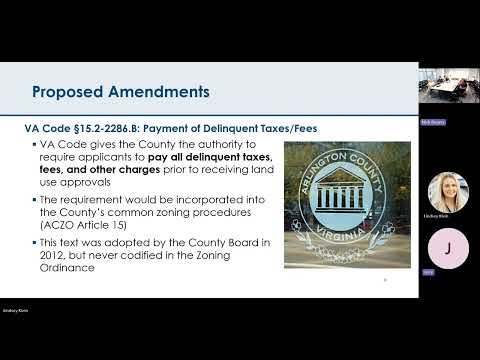
Staff also proposed clarifying that the county may require payment of delinquent taxes, fees and charges before granting certain land‑use approvals, correcting language the county adopted in 2012 that was never fully incorporated into the ordinance. Klein said staff would place that requirement in Article 15 (procedures) to make the practice explicit.
A third change would update the civil‑penalties process to allow a 10‑day appeal period for the specific categories the Code of Virginia enumerates, rather than the standard 30‑day window. Klein said the shorter period would be used in limited circumstances "where a more rapid response is needed or warranted." She clarified the 10‑day timeframe would be counted as calendar days.
Committee members asked staff detailed implementation questions. Several members sought clarity on whether commonly seen temporary cell towers — such as those brought in by carriers to fill service lapses or for events — would fall under the new temporary‑structure definition; Klein said staff will develop an implementation process (described as a zoning certification) and will follow up with specifics for operators. "If the building permit is required... then a building permit would still be required," she said, adding that structures that meet the statute’s criteria may not need a building permit.
Members also raised equity and enforcement concerns about commercial‑vehicle rules and shortened appeal periods. One committee member asked whether the changes could ‘‘penalize people because they have to have that right’’ to keep work vehicles when they lack a garage, highlighting the committee’s interest in how enforcement would be applied in residential neighborhoods. Staff noted the zoning ordinance already contains a multi‑criteria commercial‑vehicle definition (including vehicle weight, passenger capacity, use for hire, and food‑truck exceptions) and that enforcement is complaint driven; staff agreed to show side‑by‑side language and examples at a future briefing.
On the process, Klein said the county board authorized initiation of the broader package in May and staff will ask the board to authorize advertisement of these amendments later this month, with hearings planned no earlier than October. She said the three targeted items are part of a larger set of 13 amendments; higher‑profile items from the 2026 session will be scoped and return to the committee later.
The committee had no formal motions or votes on the proposed changes at the July 16 meeting; staff will refine the draft language, prepare comparative materials, and return to the committee and the county board for the advertisement and hearing process.