Get Full Government Meeting Transcripts, Videos, & Alerts Forever!
Get email alerts on the Defense Supplemental topic
No spam. Unsubscribe anytime.
Chair urges reconciliation to pass $67 billion defense supplemental, voter ID and food-security measures
Summary
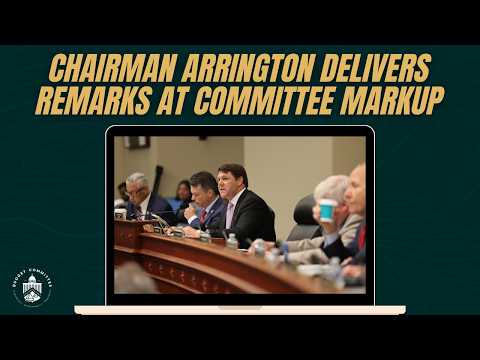
In opening remarks, the committee chair said Republicans will use reconciliation if necessary to pass a $67 billion defense supplemental to provide battlefield readiness, strengthen the food supply and advance voter-ID measures, and criticized Democratic opposition as obstruction.
The chair told the committee in opening remarks that Republicans plan to use the reconciliation process if needed to secure a $67 billion defense supplemental and to push measures on food security and voter identification.
"This is a defense supplemental. It should be bipartisan," the chair said, adding that if regular order fails Republicans will use reconciliation to provide "baseline readiness" — "just the bombs, bullets, and battlefield readiness" — for U.S. service members. The chair explicitly gave the supplemental a dollar figure: "$67,000,000,000." He framed passage as necessary to support troops "in time of conflict."
The chair tied the defense request to a broader political argument: he said the 2024 election returned unified Republican leadership and credited that leadership with border enforcement, trade changes for farmers and workers, and increases in defense and border-security spending. He accused House Democrats of obstructing legislation and forcing Republicans to rely on reconciliation, saying Democrats twice blocked clean continuing resolutions and refused to support funding for ICE and CBP.
On domestic resilience, the chair called food security a national-security priority, saying Republicans will work to "strengthen our food supply" and avoid dependence on foreign sources to feed American families. He framed the issue as preventing instability that could threaten households and national interests.
The chair also raised election integrity as a policy priority, saying public confidence in elections has eroded and asserting that voter ID is essential to restore that confidence. "Voter ID is essential to the integrity of our elections," he said, adding that past floor efforts to advance voter-ID measures received no Democratic support.
Throughout the remarks the chair made numerical claims about government fraud and savings, including a repeated assertion that roughly "$500 billion a year" in fraud leaks from the government and a separate figure of $1.6 trillion said to have been identified in savings. Those figures were presented as the chair's characterizations and were not corroborated within the remarks.
The chair concluded by addressing the ranking member and urging unified Republican action to complete the agenda; no formal motion or vote on the supplemental or related measures was recorded in the remarks.
Next steps: the remarks were an outline of priorities and tools (including reconciliation) the majority plans to use; the transcript did not record a scheduled vote or specific legislative text for the $67 billion supplemental, voter-ID language, or food-security proposals.