Get Full Government Meeting Transcripts, Videos, & Alerts Forever!
Get email alerts on the Environment topic
No spam. Unsubscribe anytime.
Town board pauses Skajakwita Creek sponsorship after funding, bond questions
Summary
Town planner Dan Young outlined a $6.7 million Army Corps/Buffalo Niagara Waterkeeper ecosystem restoration for Skajakwita Creek; board members pressed whether the town would only cover interest on bonded local matches or principal as well. Because questions about documented federal/state reimbursement remain, sponsors agreed to pull the resolution for further review.
Dan Young, the town planner, outlined a $6,701,000 aquatic ecosystem restoration plan for a segment of Skajakwita Creek that the U.S. Army Corps of Engineers and Buffalo Niagara Waterkeeper developed, saying the feasibility study recommends two-stage channel reconstruction, restored riparian buffers and invasive species removal.
Young told the Town of Cheektowaga board that the federal share is about $5,025,000 and the nonfederal local share is described in the draft as $1,675,000 plus a small additional local amount. “We’re right now looking at the opportunity to use state funds to unlock that federal funding,” Young said, describing the New York State Water Quality Improvement Program (WQIP) as a competitive, reimbursement grant that would require local matching funds.
Why it matters: The project would bring federal investments for stream restoration and habitat improvements to town property and adjacent parkland, but it also requires local financial planning before construction. Board members focused on who ultimately bears borrowing costs while the town fronts grant matches.
Supervisor (meeting chair) summarized the practical risk: if the town must issue bonds to front the state match, the town would likely absorb interest costs between roughly $400,000 and $500,000 over the life of a bond absent written guarantees from state or federal sponsors. “If we are taking out a bond to front the state portion and get reimbursed through this grant, yes, you’ll get reimbursed — but only on the principal,” the supervisor said, citing the town’s likely exposure to interest costs.
Young and other staff repeatedly stressed the contingency language that had been drafted into the resolution: if the Army Corps or other sponsors do not provide a written reimbursement agreement before grant submission, the town may withdraw as the nonfederal sponsor and relinquish responsibilities. Young said the town would be responsible for securing the WQIP match and for demonstrating a financing plan to state reviewers; he also said that Corps continuing-authorities funds had been discussed as a potential source to cover local-match obligations but that nothing was finalized.
Board members probed alternatives to bonding: one suggested tapping reserves to reduce interest costs; another asked whether federal sponsors could advance funds directly. Young said he had asked but had not received a definitive answer from the Corps.
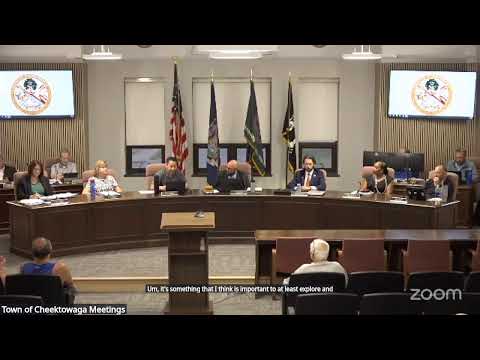
The board did not vote on the resolution. After extended questioning and recognition of competing draft language, the supervisors and sponsors agreed to pull the resolution to allow counsel and staff to reconcile financing language and seek documented assurances from the federal/state sponsors before formal action.
What’s next: Sponsors said they could bring the item back when paperwork from the Corps and the state clarifies reimbursement mechanics and when the town’s finance office supplies a clear plan for any bond or interim financing. The resolution was pulled from tonight’s agenda for further review.