Council reviews editorial and correlation corrections across building, fire and mechanical codes
Summary
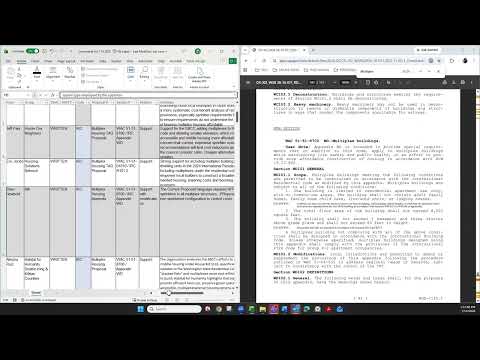
Staff walked the council through numerous editorial corrections and correlation issues in the draft CR-102/WAC materials—fixes include table numbering, bore vs. bored/holes wording, special-wind-region mapping, NFPA reference updates, and EV‑charging cross‑reference corrections; these items were characterized as editorial and will be corrected or returned with specific language as needed.
During the July 14 special work session, staff presented a lengthy set of editorial and correlation corrections flagged in public comments, oral testimony and internal review. Items ranged from minor drafting fixes to cross‑code correlation adjustments that staff said should be aligned before publication. Specific editorial items discussed included:
- Clarifying wording for boreholes vs. notch/bore language in structural sections (suggested change from “bore” to “hole” in figures and text). - Updated mapping and a five‑mile transition zone for the Special Wind Region graphic tied to ASCE 7 analyses. - An editorial numbering correction in appendix T102 footnotes (user note numbering and renumbering items shown in the draft). - EV charging and vehicle-space cross‑references (11.07.2.2) and a recommendation to mark some subsections as "not adopted" to avoid conflicts with other provisions. - Requests to update NFPA reference editions so building and fire code citations align (for example, updating to the 2023 NFPA reference where the fire code has moved forward). - Corrections in mechanical code refrigerant tables to align with ASHRAE 34 safety classifications and concentration limits and to include missing table lines.
Staff characterized most of the items as editorial or correlation fixes and said they would produce corrected language where necessary; in a few cases staff flagged items that will require further work (for example, where a proposal was bounced back to the council for correlation or where an amendment had substantive mapping changes). Council members asked clarifying questions about tracking changes and the posting process; staff said an amendment tracker will be used and urged members to post proposed amendments so they can be reviewed in upcoming sessions.
No formal votes were held on editorial items; staff will return with corrected language or proposals as appropriate in subsequent meetings.
AI generated
The text on this page is AI generated. Summaries, highlights, analysis, and video transcripts are all produced from the original source material.
AI can make mistakes, so if you spot one, and we will fix it for everyone.
Note: the source content is unaltered by us. Any content source we link to, be it a video, an audio recording, or a document, is presented exactly as its publisher released it. That publisher is usually a government body, sometimes an individual official or another organisation.